ROUTE FUNCTION
LIST OF STOPS
- LIDOVÉ SADY-ZOO
- Riegrova
- Botanická zahrada
- Muzeum-Galerie Lázně
- Průmyslová škola
- Ulice 5. května
- Šaldovo náměstí
- Fügnerova
- RYBNÍČEK
The number 1 is, naturally, connected with the very first tram line in Liberec. Line numbering, however, was not introduced until after more than 27 years of operation, so the earlier part of the history relates to the section of track that subsequently received the number 1.
- 17 May 1897: construction of the first tram line from the railway station to the municipal grove began.
- 25 August 1897: operation began on the Nádraží - Městský lesík section (today the Botanická zahrada stop).
- 11 November 1897: the line was extended to Lidové Sady.
- 1907: the Šaldovo náměstí - Lidové Sady section was double-tracked.
- 13 December 1924: numbering was introduced and the Nádraží - Lidové Sady line received the number 1.
- 6 September 1933: the line was extended to the bakeries (today Staré Pekárny), which, thanks to the earlier-extended line 3, created a combined interval of 5 minutes on the Lidové Sady - Pekárny section.
- 24 November 1934: a new line no. 4 (Lidové Sady - Pekárny) was introduced to the bakeries, and line 1 was shortened to the Lidové Sady - Nádraží section.
- 1936: as part of austerity measures, the line was briefly used only as needed, as a reinforcement.
- 1945: during the war years, operation was frequently restricted due to a shortage of electricity or labour. Line 1 was again operated rather sporadically as a reinforcement, and after the war it was no longer introduced, so for a time the number 1 disappeared from service.
- 1950: a renewed operation of line 1 in an "as needed" mode on the Nádraží - Lázně section is recorded.
- 1 January 1961: the line reappears as a regular one on the Lidové Sady - Pekárny section.
- 2 January 1964: during peak hours the line was extended to Vápenka.
- 3 November 1965: the whole line was extended to Vápenka.
- 4 August 1979: the line was discontinued. According to some sources it had already been running irregularly again in the preceding period. Its services were probably gradually replaced by line 4 services.
- 1 September 1990: after an optimisation of the route network, line 1 reappears on the Lidové Sady - Vápenka route and thus partly replaces line 4.
- 1 January 1997: the line was shortened to the Lidové Sady - Viadukt section.
- 30 August 1998: the line was discontinued, partly replaced by line 5, which was extended to Viadukt.
Lines 1, 2 and 3 serve a single tram route, so they share the same local-geography article.
A link between forests
As I get to know more and more tram routes in other cities in the Czech Republic and abroad, I have no doubt that this is one of the most beautiful. The section from Šaldovo náměstí to Lidové Sady in particular is, and always has been, a showpiece. What other route links the forests of two different mountain ranges, passes through a beautiful First-Republic district and takes you all the way to a ski slope? On the 3 you can get from the Ještěd–Kozákov ridge to the edge of the Jizera Mountains in half an hour. And as a bonus you pass several Liberec landmarks, such as the former spa building, the North Bohemian Museum and the oldest zoo in the Czech Republic.
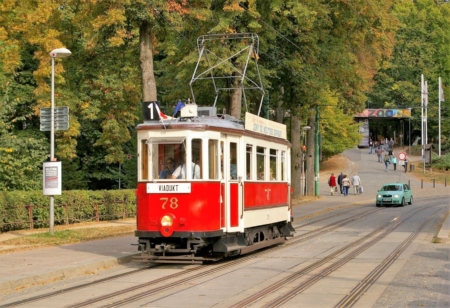
A section of contrasts
The route begins at the Lidové Sady terminus, which lies right next to the Jizera Mountains forests, the entrance to the zoo and a long-standing cultural centre. The route begins in that very showpiece Liberec district. It was a showpiece already during the First Republic, when it was built. Its importance was much greater back then; today, sadly, the culture of this district has largely been replaced by shopping centres. We drive around the zoo with its adjacent park, pass the Větrník Children's and Youth Centre, which probably every Liberec local has visited at least once, and stop by the little pond with a fountain. The pond still belongs to the zoo and we can spot pelicans and other exotic birds here. A path leads around the pond to the zoo exit, and nearby those who remember can recall the former entrance to the zoo. We continue along a beautiful lime-tree avenue, behind which rise majestic First-Republic villas with large gardens and exotic trees. An incredible sight, especially in autumn, when the whole avenue turns yellow to red and you ride a tram beneath it towards the evening sun.
We also pass a once-renowned night club in Liberec, which too is now only a memory. In the middle of the avenue we stop by two of the most beautiful Liberec buildings — the already-mentioned spa, now serving as a gallery, and opposite it the North Bohemian Museum. The avenue continues all the way to another beautiful old building, the secondary technical school. Next to it rises the building of the Liberec exhibition grounds with the new technical museum. The steam locomotive Adolf was also moved here from the railway station and proudly watches the traffic on the tram route. Where are the days when tens of thousands of people, not only from the Czech Republic, came to the regular Liberec Exhibition Fairs (LVT)… Then comes an inconspicuous bend and the surroundings change completely. We find ourselves in a narrow, cramped little street lined with small shops and modern cafés. We pass through it, and as soon as the so-called "lentils" (let us say the tram traffic lights) let us go, another rapid change occurs. The calm cramped little street releases us straight onto the busiest and most complicated junction in Liberec — the Šalďák, where 6 streets meet. In a moment we have gone from the First Republic to the 21st century. We descend the little hill past the majestic savings-bank building, then along the dark Rumunská street with its apartment blocks, and we are at Fügnerka — the public transport terminal.
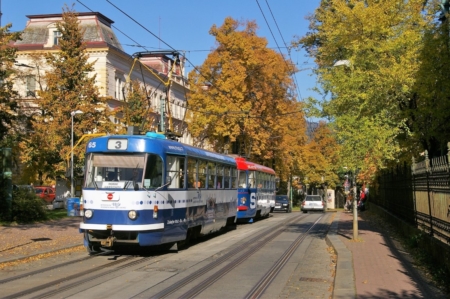
The season matters
The section described is something I — and not only I — associate mainly with weekends at the zoo, at the botanical garden (both the oldest in the Czech Republic), at the forest lido, at the museum, or simply with summer walks along Masaryčka, that well-known avenue between the villas. Right beyond the terminus in Lidové Sady begin kilometres of Jizera Mountains forests; nearby are the forest lido, the Liberec Heights (Liberecká výšina) and even a former open-air cinema. All wonderful places with faded glory (some, fortunately, gradually being restored). But just as vividly I recall the night-time and early-morning journeys home from parties — whether from Huť (the mentioned closed club), which adjoins the avenue, or from some club at the Harcov halls of residence, back when the early-morning 15 did not yet run and a tram from Liďáky was just at hand. A ride along this section at the break of dawn (albeit with a hangover) is also second to none.
Right at the time I am writing this article, replacement bus transport runs on this section, for which 20-year-old articulated Karosa 941-series buses were acquired from Prague. A truly unusual ride for 2019, both from the passenger's and the driver's point of view.
The interlaced track ends
From Fügnerka we set off slowly past the new department store in the lower centre. Many a Liberec local will remember the old, original Ještěd department store that once dominated the lower centre. I do not want to get into debates about which of them was more tasteful. Next come the house of culture, a side street to Stamina (another defunct club of dubious sorts), the turn-off to the Rybníček depot, and then the long hill straight up to the railway station. That hill which people climb every day on their way from the public transport terminal to the railway and bus stations. We also pass the famous Hotel Imperial, today run by a private company. At the very top of the hill we find the odd functionalist Uran building, the place where the old customs house and the stations themselves once stood — railway on one side, bus on the other. At Viadukt, to which we descend again, we then find a loop marking how far the metre gauge reaches alongside the standard 1435 mm gauge. Between Lidové Sady and Viadukt there is thus a so-called interlaced (gauntlet) track. At Viadukt the occasional runs of heritage line 1 also end, its vehicles being operated precisely on the narrow gauge. Viadukt is an interesting place on the route from another point of view too. Although we are only halfway along the route, from this moment to the end of the line it is uphill all the way — more or less, but always.
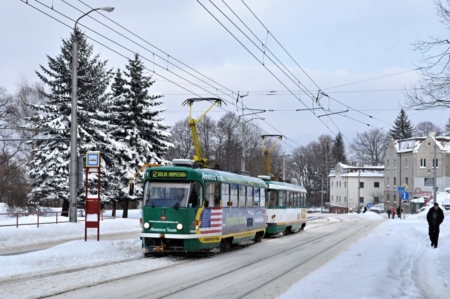
The roller coaster begins
We continue through a district full of ordinary apartment blocks whose density and height gradually decrease. A more interesting building is the former old bakeries, after which the adjacent stop is named. For me the stop mattered in my grammar-school days (Jeronýmova). It is quite far from the school from this stop, and today line 17 runs directly to it, but back then it did not, and even today many students prefer to use the tram. The Staré Pekárny stop matters for sports fans too, for the same reason. Right next to the grammar school there are several sports facilities, including the hockey arena. After matches of the Bílí tygři (White Tigers) we therefore encounter here a surge of crowds of fans streaming down the hill from the arena, whose mood depends on the result of the match.
A little further on there used to be a loop where line 1 or 4 once terminated. Later only a siding remained, for reinforcements precisely in the case of hockey or other sporting events. Ironically, it was never used. We pass under railway line 086 to Česká Lípa, pass the odd, now needlessly large Horní Růžodol station, and emerge at the "U Horizontu" junction. The name derives from the adjacent functionalist service centre for the local typical socialist housing estate. The centre ended up like most of the others — a dilapidated building with a non-stop shop, a second-hand shop and one little grocery, where time has stood still.
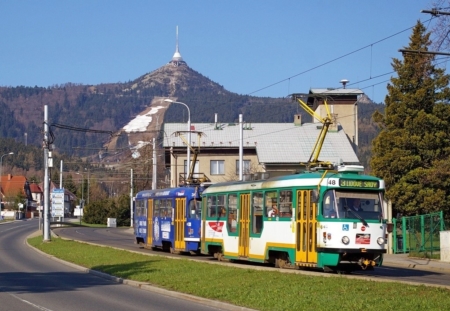
At the junction we cross at a right angle with bus line 22, and around the corner there is another loop, this time for line 2 – Dolní Hanychov. Beyond it only line 3 continues. The loop is, with rare exceptions, used only on weekdays. As soon as we leave Dolní Hanychov, Ještěd begins to draw dramatically closer and we climb more and more. The feeling of the city leaves us, and after passing the Ještědská primary and secondary school it gives way to more of a village, with a mix of older and newer family houses and an old church. Guesthouses for tourists also increase and the landscape begins to take on a mountain character. In winter it is precisely here that you can notice there is markedly more snow than down in Liberec. At the very end in Horní Hanychov we feel that Ještěd is just a stone's throw away.
We are at the second terminus and again at the start of kilometres of forests. In winter it is only a few hundred metres to the ski lift; in summer it is a short way to the cable car that takes us all the way to Ještěd. From one nature park into another. No surprise that we are also at the highest-lying tram stop in the Czech Republic (522 m above sea level). After getting off the tram we can pass through the "gate of champions", a memento of the 2009 World Ski Championships. For some a sweet memory, for others rather a bitter one.