ROUTE FUNCTION
LIST OF STOPS
- Škola Kateřinky
- Kateřinky les. správa
- Kateřinky Zlatá ulička
- Pod Záložnou
- Nad Pianovkou
- Janův most
- Obzor
- Pavlovice křižovatka
- Letná
- Hrdinů
- Vrchlického
- Dopravní hřiště
- U Dvora
- Sokolská
- Šaldovo náměstí
- Fügnerova
- Košická
- Melantrichova
- Čechova
- Mostecká
- Rochlice
- Slovanská
- Na Srázu
- Jeřmanická
- Vesec samoobsluha
- Vesec U Střediska
- Mařanova
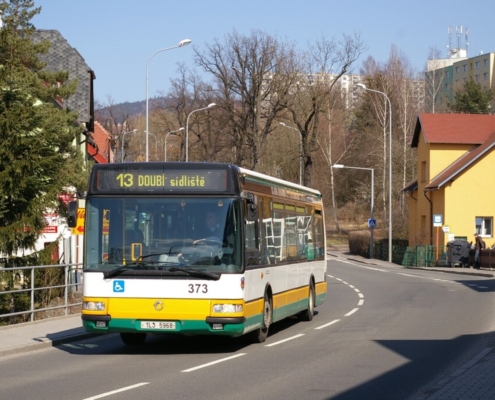
- Doubí sídliště
- Doubí sídliště
- Mařanova
- Vesec U Střediska
- Vesec samoobsluha
- Jeřmanická
- Slovanská
- Rochlice
- Mostecká
- Čechova
- Melantrichova
- Košická
- Fügnerova
- Šaldovo náměstí
- Sokolská
- U Dvora
- Dopravní hřiště
- Vrchlického
- Hrdinů
- Letná
- Pavlovice křižovatka
- Obzor
- Janův most
- Nad Pianovkou
- Pod Záložnou
- Kateřinky Zlatá ulička
- Kateřinky les. správa
- Škola Kateřinky
- 14 October 1957: selected services are extended all the way to Rudolfov, to the power station. At the same time the line is reinforced by line 12 services to Janův most. Later the extended line 13 services are shortened to the Vocational Apprentice School of Production Cooperatives (Škola Kateřinky) and the line 12 services only to Tesla (Pavlovice křižovatka).
- Between 1992 and 1996 the evening and weekend services are replaced by line 24 services, which was de facto a foretaste of the new three-line system.
- 1 January 1996: line 13 is, together with line 26, extended to the Doubí estate, thus becoming, for most of its route, part of the three-line group 13, 24, 26 in its present form.
- 30 September 2024: after the reconstruction of Sokolská street, the Sokolská most stop was abolished and a Sokolská stop was introduced in the direction from the centre at the site of the original suburban-transport stop.
Line 13 is among the longest and my favourite ones. The problems of the section between Doubí and Pavlovice křižovatka are the same as for lines 24 and 26 — frequent delays and overcrowding of services at peaks; otherwise, however, it is a fairly trouble-free section. The section from the junction to Kateřinky is then like another world. In the narrow valley you have to watch out for sharp bends where you cannot see around the corner, and also for poles and rocks jutting into the road. Passing other vehicles at these spots can be unpleasant. A trip through Kateřinky at a summer sunset or during a winter calamity is, however, always an experience. I filmed one such experience after a winter thaw with an Iveco Urbanway CNG #542. Right after leaving the school, however, one of those unpleasant encounters occurred, where I even had to reverse...
Finally, the last two line 13 services towards Kateřinky, which arrive at the Pavlovice junction as line 25 from Broumovská and only switch to line 13 there. Beyond the Na Pískovně stop you can see a number-switching line 12/28 service which departs alongside this one from Fügnerova in the collective departure (in the footage you can hear the dispatcher's departure signal). The services share a route from the Hlávkova x Generála Svobody junction to the Janův Most stop.
First, the Pavlovice křižovatka - Kateřinky section will be described, which is unique and specific to this line. The Doubí sídliště - Pavlovice křižovatka section is shared with lines 24 and 26 and is therefore described in the second part of the text.
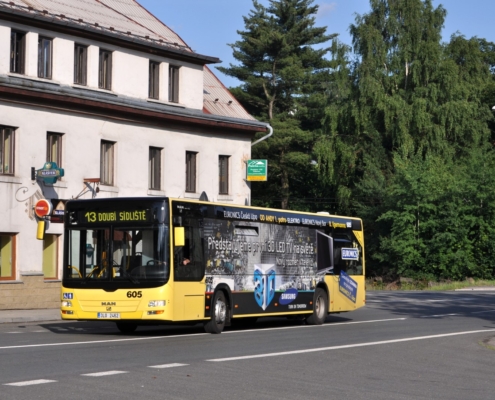
The section begins at the large Pavlovice křižovatka loop, where most line 24 services end. To this day locals call the place either "the junction" (křižovatka) or "u Litesu" (by Lites). Right next to the loop stands the architecturally significant factory building of the Siegmund brothers, which later became the seat of the Lites company, which still makes fire-safety equipment today. Indeed, the loop too used to be called Pavlovice Lites. An important crossroads, however, had been here long before Lites. We must not forget the Staročeská restaurant, well known throughout the wider area, though hardly anyone calls it anything but "Na kříži" (At the Cross). It is right in front of it that the 13 turns off to its stop, separate from the loop. Opposite the stop, by the way, is the former villa of the Siegmund industrialists, around which there used to be a landscaped park. Today it is noticeable only on an attentive walk through the local wood. In it you will find old fence posts, ornamental trees that do not belong in a Czech wood, and even the foundations of gazebos and a swimming pool! On the top of the hill above the park there then stood, until the Second World War, the Siegmund lookout tower.
Through the valley of the Černá Nisa
But let us continue along the route of the 13. For now it does not continue entirely alone, because line 28 services and selected line 24 services run here, both to Radčice (not back). Before you know it, the surrounding world changes completely. From the trunk road on which the 13 arrived from the city, you find yourself on a smaller road in a fairly deep mixed forest in the valley of the Černá Nisa river. On the left a steep slope, rocks and trees, on the right the riverbed. Apart from a few warehouses and ruins, the route does without civilisation for a long time. Although the valley is deep and the sun reaches it only rarely, the banks of the Černá Nisa here were a popular recreation spot. This is proven by the fact that they were once nicknamed the Adriatic (Jadran). Today you would hardly see anyone sunbathing there, but the place is still considered an interesting tourist destination. After this wooded section we reach Janův Most. Here the first houses and old factories appear, which made use of the swift flow of the little river. Here lines 24 and 28 also branch off and head into the surrounding hills. We, however, continue along the valley.
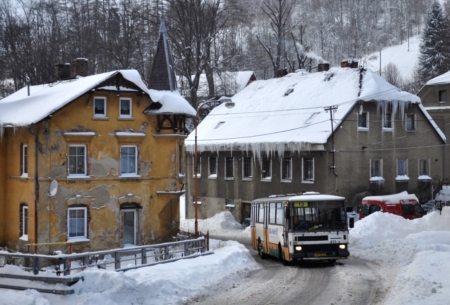
The valley's former glory is now recalled only by the names of stops and streets and the ruins of once-majestic buildings. And so we learn that we are passing the building of the famous Pianovka (piano works), that there used to be a credit union here, and we see many other once-important factories, mainly textile ones. Right around the building of the former Seidl&Sohn piano works runs a very awkward bend. The building is still partly in use today.
The first Liberec industrial zone
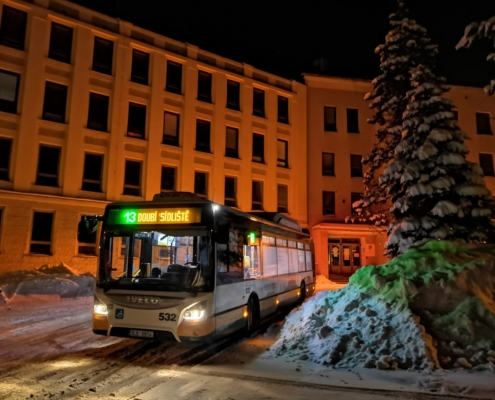
Today's modern plants no longer need the natural fall of the water as a cheap source of energy; the valley is moreover narrow and hard to access, so new companies are not exactly rushing here. Nevertheless, some plants still function, at least in part. Probably the only legend that still functions as before is not an industrial building but the U Dobráka restaurant. It is precisely today's desertedness and faded glory that give this valley its unique atmosphere. As if the spirit of the famous industrialists were still felt there. As if the clamour of long-ago workers could be heard alongside the rushing of the Černá Nisa. The veil of night completes the work, when the Kateřinky valley is especially dark. The local winters have their charm too, when snow lasts longer in the secluded valley than in the surroundings. One of those more interesting winters is, after all, shown in the picture.
Forest, fresh air, water and snow
The first terminus comes after an awkward narrow section passing the amazing villa of the industrialist-nobleman named Salomon von Hohenweeb. Back in the former regime it housed an eye sanatorium; afterwards it was abandoned. The ruin of the villa was, sadly, demolished a few years ago. Until then it resembled the classic horror films that revolve around the past and appearance of some house. By the forest administration office (lesní správa), after which the terminus is named, there is, besides it, also a scrapyard. Here most line 13 services end. I like it best when there is a long break there. Here one can already savour the clean Jizera Mountains air and the quiet, disturbed only by the murmur of the Černá Nisa's water in its stony bed.
A school in the middle of the Jizera Mountains
Selected services on weekdays and on Sunday evening continue through the Jizera Mountains forest all the way to the secondary school with a boarding house. Here, on part of the route, it joins the route of line 18. Right at the junction where they join, line 13 circles an interesting villa that now serves as an asylum house. After a few hundred metres of road that cuts into the steep valley, it reaches the Škola Kateřinky complex. This school has always fascinated me with its location. Completely cut off from the city, it is separated by several kilometres of pure forest. The sports field is wedged into the narrow valley of a mountain torrent. Where else is there anything like it? The services turn around in a tiny courtyard in front of the school's main entrance. Although the school is completely isolated, it can be very busy at some times. In the afternoon, besides line 13, line 18 and the special fast school line 53 come here to take students away. On Friday afternoons another special school line, 54, is added, which takes students directly to the railway station.
The three-line group made up of lines 13, 24 and 26, which share most of their route, is unquestionably my greatest "favourite". From an early age I rode it from Doubí to Pavlovice to visit my grandmothers. Later in childhood and adolescence I rode it daily to ZŠ Vrchlického, then to grammar school, to pubs, to the authorities, on trips, to the Prague bus for university, and so on as life went on. So I mainly used the part between Doubí and the centre, but occasional trips to Pavlovice and other parts continued. And today I am part of it again, but no longer so much as a passenger, rather as a driver. On today's shift, in fact, I have one round to Radčice, two to Krásná Studánka and the last all the way to Stráž ahead of me. So it can be said that this three-line group has become, in its so-far unchanged form, an unshakeable part of my life. It has been so for almost 30 years. I know every house here, every hole in the road. I know, and have often seen, how various buildings have come and gone along the route over time, as the city constantly changes. If I were to write down all these memories, it would fill a whole book about a single bus line. In this article, of course, I will be more concise.
Insensitively placed housing estates
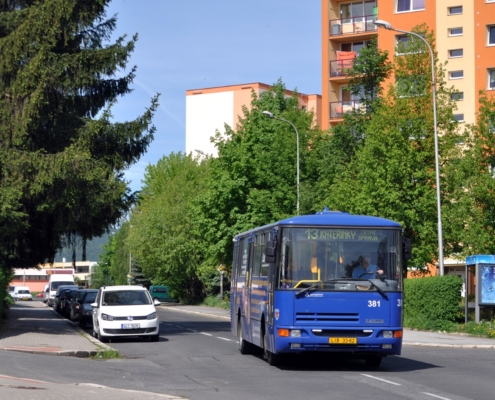
The southern end of the route serves two Liberec estates, Doubí and Vesec. There the route is characterised by a dense network of stops. Although Vesec and Doubí used to be small picturesque villages just outside Liberec, old original houses are now few in these locations, and most of them lie further from the bus route. The village character full of meadows and fields was changed in the last century by giant concrete colossi — panel blocks built on extensive green meadows. We drive around the Doubí estate on its southern side, opposite which we find smaller terraced houses. Beyond the traffic-light junction, where there used to be trees, we also pass a relatively new football pitch, which, however, is already in the Vesec cadastre. By the roundabout we pass an old, now barely noticeable bus turning loop and drive past the majestic Vesec school with its Sokol hall, which still recall the old days of quality architecture. A little further on, however, panel blocks begin on the right, on the left there is still an old post office with a shop, and beyond that older and newer villas. But these last only a moment, and soon more giant "rabbit hutches" appear on the left. On the right the long-dilapidated building of the Libena factory is worth mentioning. After leaving the estate we descend a steep hill past a timber shop that I remember there from childhood. Below the hill comes a passage through a once-whole, now divided and modern industrial plant. After a sharp bend, with a small ghetto on one side and a former pub and gym on the other, we reach a level crossing that separates the next stage of the route.
Through the valley of the Lužická Nisa
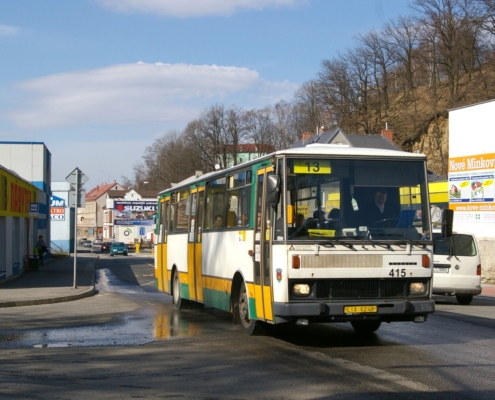
The level crossing can hand out a delay of several minutes too. Right beyond it we enter Poštovní náměstí, where the first tram route in Liberec once ended, and a bus line ended here too. Now, however, no one would even think of it; the square changed beyond recognition around the new millennium. It is characterised rather by the fact that part of it is hidden under the flyover of the Liberec–Jablonec expressway. Another peculiar characteristic of this square is that on it and in the immediate surroundings there are about 4 non-stop bars/gambling halls. I never figured out why they concentrate right there; I never saw a large number of people in them, but they have survived there for years. On this square our three-line group also joins lines 20 and 37 and continues with them to the centre along Dr. Milady Horákové street. It is lined on both sides by older houses with various services, behind which, on the left, the Nisa river is hidden, on the right more houses and, right next to them, a rock massif on top of which the edge of the Rochlice estate is visible. The houses are occasionally replaced by various facilities, such as the Kaufland store built on a former factory. Other old factories in the Nisa valley did not get demolished and were rebuilt. Beyond the Čechova stop the main landmarks are the law school and the Liberec heating plant and incinerator. The houses on the right grow larger, but only up to the next traffic-light junction by the Melantrichova stop. On the right it is lined by a strange no-man's wood before we reach a petrol station and more villas. On the left various industrial facilities continue.
The busy city centre
The junction with Košická street, in my eyes, separates another stage — the stage of the centre. For now we still skirt a little park and more villas, but soon we reach the tall buildings of the regional authority, the S-tower, the labour office and others, which mark the approaching Fügnerova public transport terminal. Suddenly we find ourselves in the lower centre of the city, full of shops, restaurants and the Fórum and Delta department stores. Those who remember will recall the old Ještěd department store, which had its die-hard supporters and opponents. As we extricate ourselves from this airy space, we find ourselves in the somewhat darker 8. března street, lined with fairly tall old apartment houses. Soon, however, we pass the Liberec little chateau and suddenly find ourselves in another airy space dominated by the Plaza shopping centre and the largest Liberec junction, Šaldovo náměstí. With the bus we split off onto a dedicated road shared with other lines, including tram lines, which directly adjoins the Plaza. After overcoming the Šalďák, we again plunge into a narrow dark street between tall houses that remember much. One of them is the old post office, still the main Liberec post office today. We briefly glimpse the F. X. Šalda Theatre and the town hall, but quickly disappear at the stop under the bridge on Sokolská street. Beyond it we can again briefly glimpse the modern regional research library and, downhill, leave the city centre at greater speed.
The calmer part of the route
At the next traffic-light junction we turn left and the character of the city changes again. The rest of the route follows a road hundreds of years old into the northern corners of Bohemia. At peak it tends to be fairly busy, but on quiet evenings it can be driven the whole way without stopping. In general this half of the route is much calmer than the first part. We pass a small theatre and find ourselves on a neat straight street that blossoms beautifully pink in spring. We pass a mixture of villas and modern houses with services. Behind them we can only sense an interesting youth hostel with a rich history and architecture resembling a chateau, and a little further the Jedlička Institute by a beautiful villa district. But already we descend a sharp S-bend to the traffic playground and, opposite, glimpse the main football stadium. Dopravní hřiště (the traffic playground) is also the name of the adjacent stop, at which it does not often stop, but during a football match there can be downright crowds here. After the S-bend descent, though, we have to climb back up the hill again. We pass, among other things, a former hotel, now the Atrium retirement home. When we climb the hill to the Vrchlického stop, the strange socialist department store Merkur appears on the right. It was from here that I, with many other pupils, walked to ZŠ Vrchlického, though some also to the adjacent ZŠ Sokolovská and the Podještědí Grammar School. Beyond the next bend follows a straight with a vet's, a strange casino, and it ends with a very sharp bend, beside which stands the building of the Universum International Centre, otherwise also called the Colosseum. For decades now, cultural and educational events, among others, have been held here. Beyond the bend we soon reach the Hrdinů stop, where there is the well-known pub Václavka and a building where various services come and go over time. Up the next hill we already drive through a little wood that somewhat darkens the whole street. Beyond the wood, however, the Nové Pavlovice estate and the adjacent garages peek out. On the hill by the Letná stop there used to be a classic estate corner shop. Now motorbikes and quad bikes are sold there. The shop was replaced by a Billa supermarket opposite. But even that did not last and turned, after a few years, into an industrial building. Ahead of us is only the steep descent through an overgrown valley to the Pavlovice junction, during which we glimpse the Nové Pavlovice estate on the left and, on the right, a notorious house with notorious residents. With that this account ends. The area of the Pavlovice křižovatka loop is the terminus of the larger part of line 24 services, but it is also a place with an immensely rich history, which you could discover in the account of the remaining parts of the route of lines 13, 24 and 26, which branch here and each continue elsewhere.