ROUTE FUNCTION
LIST OF STOPS
- 1958: selected services were temporarily joined with line 17 without entering the centre, on the Ostašov - Viadukt - Stráž nad Nisou route.
- 1962: selected services were temporarily diverted via Nikose Belojanise street (today's Americká).
- 10 November 1969: the line was extended by two services to Údolí sv. Kryštofa.
- 4 August 1980: the line was extended by about 2 km to the Novina terminus, and at the same time service to Machnín was considerably strengthened (until then only one service in the morning and one in the late morning).
- 1995: part of the line's operation is provided, until 1 October 1998, by the private operator Ivan Pacák.
- 1 January 1999: due to the obligation to mark lines running beyond Liberec with three-digit numbers, the services continuing to Kryštofovo Údolí and Novina are, until the end of 2001, marked with the number 161.
- 2000: from the summer season, weekend recreational services all the way to the Křižany saddle are introduced, which, despite their not exactly high usage, have survived to the present.
Line 16 is the longest line by distance, with several faces thanks to its large number of termini. Despite the many termini, however, it has no detours like, say, line 22. The shortest services to Ostašov are in no way different from other radial lines. The more distant termini, though, are typical for their rural character, where along low-traffic roads (in a poor state of surface) we travel quite long distances, first to the outlying parts of Liberec and then to villages beyond Liberec. The services to Novina and the Křižany saddle can be called outright excursion services. The Křižany saddle terminus holds a privileged position in the whole transit network. It is served only from April to October, twice a day on Saturday and Sunday. Some drivers genuinely look forward to this experience ride along the endless narrow road, others are rather afraid of it. In any case, you can see it in the footage below with an Irisbus Urbanway #717.
Despite the line's mostly tranquil character, considerable delays can still arise on it in the centre of Liberec. They are the result of frequent jams during afternoon peaks around the big junction by the viaduct and on Košická street. The most problematic thing on this line, in my view, are the narrow roads with poor visibility. The problem is the greater the more distant the section from Liberec is. Judge for yourself.
You have been driving for quite a while along a narrow, twisting road. Every moment you awkwardly pass cars and occasionally grow unsure whether you have not driven past that terminus you have not visited for two years. And in the end, at the very forested summit, it appears after all. You are carrying no one and no one is waiting for you. This is the ordinary reality of the 16's weekend excursion services to the Křižany saddle. It is the most distant place from Liberec you can reach by public transport. Let us take a look at all the faces of this very long line.
Past the Babylon to the railway station
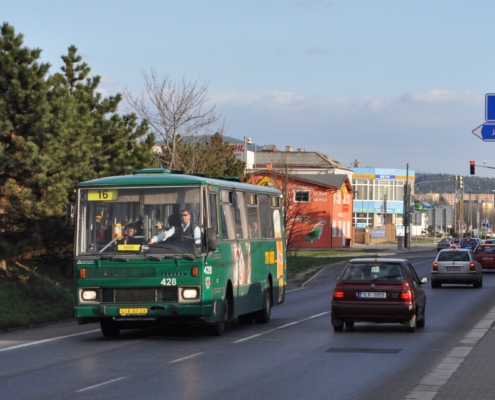
From the terminal we set out through the parking house adjoining the OC Fórum, along the one-way Blažkova street and then Náchodská. I remember the time when these streets were used only as a replacement route in case it was not possible to turn from the terminal into the then two-way Dr. Milady Horákové street. Now both streets are used, one there and the other back. A view awaits us of the tall regional-authority building, the little park with a future riverside walk and, behind it, the IQ Landia building visible through the trees. Right after that we appear at the busy junction with Košická street, into which we also turn. It is precisely this junction that causes the long queues leading to the slip road off the through route and sometimes all the way to the railway station. Along Košická, besides the building of a dubious hostel with an unsightly car park, there is the well-known Babylon Culture, Shopping and Social Centre, built from the former industrial complex of the Hedva textile mill. It was certainly better known and unique rather in the 1990s and at the turn of the millennium, however; now its spaces have an aftertaste of faded glory. Even the stop next to the building has been a request stop since 2019. We pass under the city through route, road I/35, and emerge onto a long straight running alongside buildings formerly belonging to the railway station. Today in them we find, for example, a popular café, offices or a post office. Catering establishments are found also at the place where the majestic customs-house building once stood. That is right opposite today's station hall. In front of it we have to overcome a complicated junction with the tram track, which also usually causes congestion at peak. With that we briefly join the tram track-bed.
An insensitively placed estate and the oldest Liberec house
Beyond the Nádraží stop we descend Žitavská street down the little hill, where on the left we have the northern throat of the station and on the right the bus station of suburban and long-distance transport. The tram track branches off at the place where the Sofia cinema used to be, and we join the queue at the large double junction called "u viaduktu" (by the viaduct). The whole place underwent an enormous transformation because of the construction of road I/35, for which many houses fell. Today it is probably the second most complicated junction, right after the Šalďák. Long queues often form here too. The tall railway viaduct rises above Hanychovská and Švermova streets, into which we turn. It takes us into the Františkov district. The village character was broken under the former regime by the placement of several panel blocks right among the houses and villas. Nearby, moreover, we find the very oldest house in Liberec, built in the second half of the 17th century. Past SVED and residential houses, Švermova street finally leads us to the edge of the Karlinky district. This is announced by an underpass beneath another railway viaduct, this time of line 086 to Česká Lípa.
The largest Liberec brownfield and the first terminus
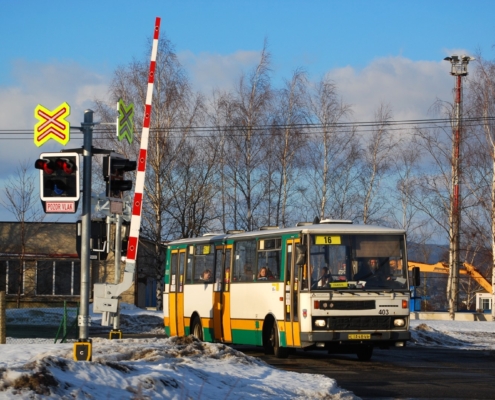
We stop at the stop opposite the well-known restaurant and continue towards Ostašov along the mentioned line. The next stop is Slévárna (Foundry), but at the time of writing it is already only a memory of the huge complex of old foundries. The whole complex is now demolished and a new brownfield awaits the realisation of grand plans. The next stop is Kovošrot (Scrapyard) — that still functions, and we can occasionally glimpse a siding running into its grounds, at the level crossing over this siding and line 086. By the crossing we have found ourselves in Ostašov, another of the many districts and villages this line serves. Here the surroundings take on more of a village character, when we reach the centre of the small village with a new nursery, school, a small square, a bus stop and, a little further, a train stop too. Descending the little hill, we reach the first terminus of the line, Ostašov, whose loop is in a kind of widened junction. Here the urban character of the line ends and the rural one begins.
Across a "tank range" through small villages
We set off further along the broken Karlovská street. Our route is suddenly lined with unexpected emptiness — on one side a meadow with a view of the railway and the Ještěd ridge, on the other an even larger plain with a view of the northern industrial and shopping zone and Liberec as a whole. In a moment the street begins to be lined with the houses of the oddly laid-out Karlov pod Ještědem district. We also reach the edge of the forest belonging to the Ještěd Nature Park. The local stops are a good starting point for trips. Honestly, I am surprised that the development in Karlov is still so sparse. There is also a second terminus here. Right beyond it follows another empty section with an almost 1.5 km long straight. The long hill must be hated by cyclists riding from Machnín to Karlov. I, however, like it. It often offers very interesting views of the variously lit city or of the meadow ending in the Hamrštejn wood. The hill ends at an old farmstead, where there is rarely any passenger frequency, and the first houses of the village of Machnín, which has been part of the city of Liberec since 1980. Apart from a few small apartment blocks, Machnín has kept the character of a village split by the flow of the Nisa river. We stay on its left bank, although the larger part of the village lies on the right one. Most passengers thus face crossing the bridge over the Nisa. Since 1859 Machnín has also been crossed by the railway to Hrádek nad Nisou, Žitava and Varnsdorf. By the Machnín stop is another terminus of our line. Most services end here, but not many people come here. Connections to trains are rather coincidental, but even so I have already seen a few transfers.
Into deep forests
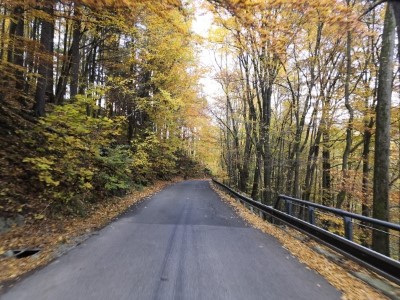
Those few services that continue further are among the most interesting in the transit network. First we definitively leave Machnín and cross the railway for the last time. This line, by the way, crosses the railway the most of all — 5 times in total, of which twice grade-separated and three times on the level. While crossing the line we can glimpse the 700 m long viaduct over the Nisa and, outside the growing season, perhaps even the ruin of Hamrštejn castle. The bus, however, now plunges into a dark forest. After a moment the hamlet of Hamrštejn still appears, today rather notorious for the peculiar residents of some of the houses. Some services, in various periods, used to run into the grounds of the Hoflana company here. A little further on we pass the fence of the well-known Kleinert villa, known as the Machnín little chateau, which also used to house an eye sanatorium. For the last decades, however, it has only been decaying, and a new owner who would restore the villa's beauty is sought in vain. With that, civilisation ends for a while. Now we have to push through a truly dark forest above the Nisa valley. The weather may be ever so clear, but on this wooded slope there is always a peculiar gloom. The passenger can watch the swift torrents flowing from the Ještěd ridge into the Nisa, but the driver has to concentrate on the narrow winding road, where every oncoming car can be a problem. As these are beech woods, this section is most beautiful in autumn, when it all turns orange. Finally we leave the Nisa valley and the landscape brightens. At the same time we join road 592 from Chrastava, which is a sign that the Valley of St Christopher awaits us, today just Kryštofovo Údolí.
The endless Valley of St Christopher
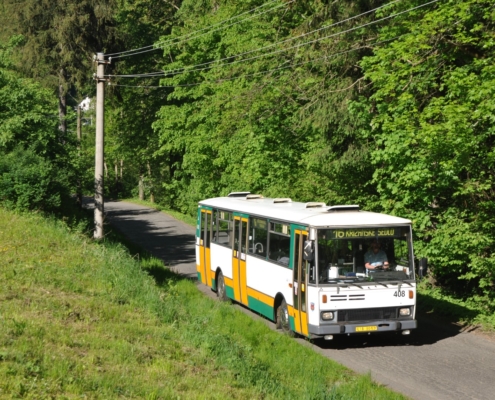
In the Liberec area there are jokes, for example about Smržovka. You drive and every time it looks like the end, more houses appear beyond the bend and Smržovka continues. Kryštofovo Údolí and the adjoining Novina are something similar. Several kilometres along a narrow undulating road on the floor of the fairly sharp Rokytka valley await us. The whole way it is lined mostly with older houses and cottages. Among them appear a few restaurants too, which profit mainly from tourism. In good weather many tourists come here by train or bus for the sights, but there are not as many as, for example, on line 18 towards Rudolfov and Bedřichov. The dominant feature of the valley is the centre of the village of Kryštofovo Údolí, with the Church of St Christopher, a nativity-scene museum, the municipal-office building and other points of interest. Every year, for example, the Kryštofovo Údolí fair is held here. The valley has the atmosphere of a mountain village in every season and at every time of day. Whether the first morning service, which arrives in a sleeping village where only the little river in the valley clatters, or the last, late-afternoon service, which in autumn departs at sunset. The sun sets here in the valley earlier than elsewhere, and so it highlights in red, for example, the frosted trees on the hilltops. After a long section without stops we finally reach the Novina loop, which is by one of the Rokytka's tributaries, and at the same time opposite the stylish Údolanka restaurant. At last the opening words come into play. If it is a weekend from May to October, the service continues even further. The road begins to climb more dramatically, narrows and twists even more. It is, however, the only way to glimpse, for example, the famous Novina railway viaduct, which has appeared in many films and adverts and has been the place of thousands of photos by railway enthusiasts. After another long section without stops the dwellings do finally thin out until they disappear entirely. That may be the moment when one wonders whether one has not got lost, but the Křižany saddle stop post does appear in the end after all. A terminus on an ordinary saddle of no great importance. The buses turn around at the mouth of some forest track. Without reversing it is difficult. When I get here, I always feel relief that I have managed it. Although it may not seem so, quite a lot of cars use the road and it contains many blind spots, so no service is short of dangerous, tight passing of oncoming vehicles. For the views of the valley, the beautiful log cabins and the play of sunlight, it is worth it, at least to me.