ROUTE FUNCTION
LIST OF STOPS
- 1965: the line was extended all the way to Minkovice u Liberce, though selected services still end in Doubí. The interval of services to Doubí was shortened to 15 minutes.
- 22 July 1967: the line was routed along Košická, Nákladní, Doubská and České mládeže streets and then along the original route. This step was probably taken so that the line would not duplicate line 2 along tř. dr. Zd. Nejedlého (today dr. Milady Horákové).
- 1970: a proposal to extend the line to Šimonovice is discussed. Due to the unsuitable state of the roads, however, their adjustment is first necessary.
- 1973: for a few months a detour to the city stadium is introduced. It did not catch on, and so it soon ended.
- 1975: the line is extended to Šimonovice.
- 1976: the line is briefly rerouted along the then-new road (today's through route across the city) all the way to the Doubská stop, where it joins its original and current route.
- 1979: the line is moved back to tř. Zd. Nejedlého, where it reinforces lines 2 and 24.
- The interval was shortened to 12 minutes due to the growing Doubí estate.
- 1 September 1990: after a major optimisation of the route network, the route was extended by the Fügnerova - Ruprechtice sídliště section, where it supplements lines 14 and 25.
- 1 January 1999: due to the obligation to mark lines running beyond Liberec with three-digit numbers, the services continuing to Šimonovice are, until the end of 2001, marked with the number 201.
- 1 February 2001: express services were introduced on the Fügnerova - Pilínkov section and back for more efficient transport of employees of the Preciosa plant. This is a foretaste of the services of the future line 37.
- 1 September 2003: the express services pass under the new line 37.
- 1 July 2004: the Fügnerova - Ruprechtice sídliště section was abolished and transferred to other lines, by which the line returns to its original route and takes on its present form.
- 1 March 2023: one morning service from Pilínkov newly turns off from Rochlice to Zelené Údolí, from where it continues as line 12.
- 1 June 2024: a new stop, and at the same time a detour, Doubí-UCT, was introduced in the area of the new UCT Fluid Delivery Solutions plant. Selected services are diverted there, mainly at shift-change times.
Line 20 is quite a pleasant line that takes the driver all the way beyond the southern boundary of the city of Liberec. Between Fügnerova and the Rochlice stop the route is the same as the three-line group 13, 24 and 26, after which it sets off on its own. Several traps await the driver, though, especially beyond the Doubí Obilná stop, where it leaves Hodkovická street. The space stops being so favourable and an encounter with a colleague or a lorry can be tricky. From the level crossing in Minkovice the winter maintenance then ends, which brings further worries. This is visible in the following video, filmed at sunset on a beautiful winter day with a Mercedes-Benz Citaro #434. The lying snow is also the reason for my manoeuvre at the terminus in Šimonovice, where I drove past the alighting stop and pulled straight up to the boarding one. This is advisable whenever the road may be slippery, because the alighting stop is tilted uphill and problems with moving off may then arise.
The section between Pilínkov and Rochlice has one more peculiarity, namely a fairly tight timetable. Any delay can, however, be made up on the next section. On the way back we travel during a November inversion, when in the higher-lying Šimonovice you can see frost on the surrounding vegetation. It was with a Mercedes-Benz Citaro #430.
In 2024 a detour was added into the grounds of a newly built plant. It is in the following footage by Jirka Tvrdoň.
And as if that were not enough, since 2023 there has been a special school service towards the centre which, from Poštovní náměstí, turns off to Zelené Údolí and from there continues as line 12.
February is in full swing and I am arriving along a wet road at the level crossing in Minkovice. As a child I used to come here for walks across the endless meadows with the villages of Minkovice and Šimonovice around. Now there is a new residential district here resembling a satellite town. It seems to me that with every further service a new house appears here, and lately it is no longer just residential but also functional buildings. Beyond the crossing the clean road turns white, sprinkled with grit. As if the world were still all right here. New houses are visible too, but the old ones still predominate. I have the feeling I am in a distant village. But we begin in the city, as always.
That a line has accompanied me all my life I have already declared about the whole three-line group 13+24+26 too. Those connected me with primary school, my grandmothers and the city centre. They were, however, further away than the 20, and so whenever possible I preferred to use line 20. When I lived in Pilínkov for one year, I did not even have any other option.
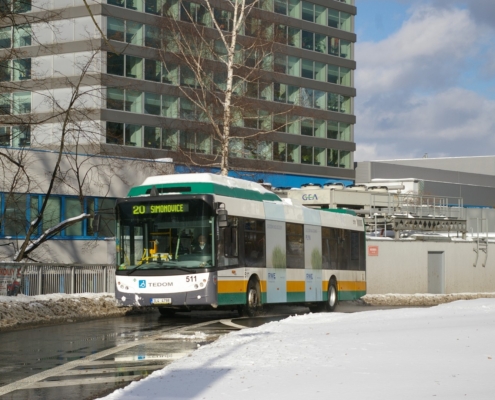
From the centre through the valley of the Lužická Nisa
From the terminal we set out through the parking house adjoining the OC Fórum, along the one-way Blažkova street and then Náchodská. I remember the time when these streets were used only as a replacement route in case it was not possible to turn from the terminal into the then two-way Dr. Milady Horákové street. Now both streets are used, one there and the other back. Some may still remember that a tram route once ran along this street to old Rochlice. A view awaits us of the tall regional-authority building, the little park with a future riverside walk and, behind it, the IQ Landia building visible through the trees. Right after that we appear at the busy junction with Košická street. We also meet the Lužická Nisa, which will accompany us all the way to Rochlice. Through the many houses, shops and industrial complexes, however, we will see it only rarely. Dr. Milady Horákové street has a similar character all the way to Poštovní náměstí. On the left there are mostly apartment houses, behind which a steep slope with rocks is hidden. On the rocks we occasionally glimpse a panel block of the Rochlice estate. The only exception is perhaps the petrol station and the little wood by U Černého dolu street. The right side conceals an extensive industrial complex of the incinerator and heating plant, then a department store and several other shops. Everything is, however, in a place where industry using the Nisa river has a long tradition.
A square full of changes
Finally we reach Poštovní náměstí with its rich history. Around a no-longer-existing house, first trams turned here, then the buses of lines 2 and 12, and finally both the loop and the house were abolished. Now the square is crossed by the flyover of road I/14. Apart from the surrounding houses, the only original thing left is perhaps the railway towards Jablonec and Tanvald, with a branch formed by the siding into the Ferona industrial complex. A train can hold the bus up by several minutes, since it has the Liberec-Rochlice stop here. We drive across the square along the main road, whereas the three-line group 13+24+26, with which we have so far shared the route, turns off to Vesec. After crossing the railway we find ourselves in a district full of larger residential houses. We do not even notice that we have passed Kyjevské náměstí, which today hardly even resembles a square. On the hill a modern industrial complex, a hotel and a smaller pub await us. All this by a traffic-light junction. It is actually a fairly strange combination, and it will accompany us further too. We can hardly notice that we have crossed the still-forested valley of the Plátenický brook, and we already appear by the slip road onto the city through route and by a petrol station. There is a lightly used stop here, yet because of it we briefly turned off Hodkovická street. Past several car dealerships, however, we return again. On Hodkovická street we pass a dubious hotel that became a hostel and several houses that, however, found themselves in the past on the edge of the Doubí estate. That originally had line 20 as its only service, but soon the three-line group took over the main function and the 20 has only a marginal role. Further on too, a mixture of older houses and smaller panel blocks will accompany us. In one of them I grew up until the age of twenty. Besides the mentioned, we will also glimpse the Kolora complex. I remember how, years ago, we watched a large fire on its premises from the balcony. The Doubí Obilná stop, which ends this stage of the route, I used several times a week for trips to the city centre, to grammar school, but also in the opposite direction on trips into nature.
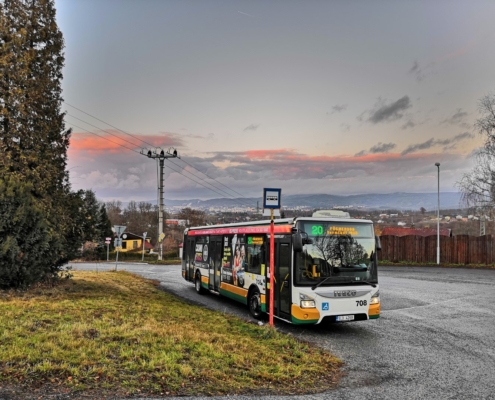
A raped village
Beyond the roundabout, by which we pass under the expressway to Turnov, a change occurs. The space gradually slows down and we can watch fairly original development, behind which the Doubský brook occasionally peeks out. The idyll is disturbed only by another new industrial building. In the centre of Pilínkov we pass very old buildings. In one of them there used to be, for example, a school. Soon, however, more small panel blocks appear too. They were built for the industrial complex of the Preciosa company, in a place that used to be a notorious prison. On closer inspection we reveal suspiciously thick walls and even guard towers. Not far from here I had my base for something over a year, when I lived in a former railway house by the local line. That, by the way, we can also glimpse beyond Preciosa.
By the complex some services end. The express line for employees, number 37, also ends here. It is a dead-end street, so the services that continue to Šimonovice have to return to Minkovická street. We drive around Preciosa once more and already appear in the village of Minkovice. At first we have the feeling that we are passing through an old village with original buildings. That really is so, but only until we reach the old village green. The original fire reservoir still exists, but around it more and more non-original buildings appear — that is, uniform modern villas crammed together. A typical satellite estate with carefully maintained hedges trimmed into little cubes and English lawns mown to a few millimetres. Development that plays at country living, although it has nothing in common with it. In recent years these houses have sprung up here like mushrooms after rain, and more are growing. There are already so many that functional buildings are growing here too. For me it is a sad sight, but still the local meadows and fields fared better than the Doubí ones, where the southern industrial zone stands. The satellite town ends for now at the railway towards Turnov, but who knows what comes next. Beyond the crossing the winter maintenance really does end, as I noted in the introduction. The video in the driver's view is proof of this. To the terminus we pass through the village of Šimonovice, which keeps its character for now, but some new little houses are already appearing here too. After all, it is a lucrative location with a beautiful view of the Liberec basin. We drive around the municipal office and a Vietnamese corner shop in an interesting building and already find ourselves at the Šimonovice terminus, which is actually just a wide junction. I like this terminus; it offers the ideal opportunity for photos with Liberec in the background. Meteorological phenomena can be well captured here. At the same time, however, they sometimes become dangerous here, mainly in winter. After all, we are already at almost 500 m above sea level.