ROUTE FUNCTION
- 30 October 1993: the line was officially rerouted onto the Fügnerova - Šaldovo náměstí - Králův Háj section, though selected morning services still continue from Šaldovo náměstí to the Jungmannova terminus and back without a detour to Fügnerova.
- 1 July 2004: the line is newly routed Fügnerova - Králův Háj directly along Na Bídě street in both directions. The connection of Králův Háj with the polyclinic and the upper centre is taken over two months later by the extended line 36.
- 1 June 2007: the line takes on its present semi-circular character, Králův Háj - Fügnerova - Šaldovo náměstí - Králův Háj. At the same time, operation of line 36 to Králův Háj and of the school services ends. From the latter a new line 52 is created.
- 16 July 2023: in the direction from the centre the line newly calls at the Šaldovo náměstí stop on the tracks, where all the other lines stop too. The stop on Jablonecká street is abolished.
Line 21 is a fairly short semi-circular line which, from the drivers' point of view, has two peculiarities. The section from Králův Háj to the main road by Textilana is one of the steepest in Liberec and is partly cobbled. On the way down, especially in winter, this can cause adhesion problems. Several times each winter, during rapid snowfall, it regularly happens that traffic on this section has to be temporarily halted until it is sufficiently treated. The way up, in turn, gives some less powerful vehicles a hard time. Jams in the centre during peak hours can also be an occasional problem.
Drivers generally do not much like shifts that include Králův Háj. It is usually a few tedious hours of 'racking up' lots of short rounds of this line. NOTE — in the direction from the centre, unlike in the video, the stop now used is Šaldovo náměstí on the tracks, not on Jablonecká street.
"Bagr" (literally "digger") is, in transit-driver slang, an urban line that has a short route and a short interval. In large cities it usually serves as a shuttle, for example from a large housing estate to the metro, train and the like. The only Liberec line that comes at least somewhat close to this definition is line 21.
As the line is short, so the local-geography article will be short too. The line essentially passes through only two districts — Králův Háj and the city centre. Most services set out from Králův Háj, so we will begin this journey right here, at the cramped terminus where a standard bus barely turns around.
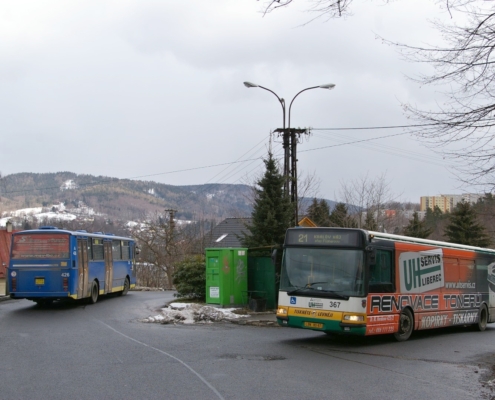
The oldest Liberec housing estate
The loop is in a place where the slope already heads towards the Harcov side. The view of the opposite hill is spoiled by several First-Republic houses and villas that are all around. One such serves the ancient restaurant U Krakonoše and still generates cheerful evening passengers. Very soon, however, we come across the first apartment houses too. At the U Vodárny stop we cross the horizon and the route arches into a fairly steep hill towards the centre of Liberec. We first pass the later construction of classic 1960s panel blocks, later also the first terraced houses of the 1950s, still with a gabled roof. Here and there, however, a house still appears that, from the earlier sparse settlement, fell into the captivity of the first Liberec housing estate. There is also the classic, now faded, socialist service centre and, opposite, a school, today serving the Secondary School of Gastronomy and Services. That supplies our line with a surge sort of student passengers, because otherwise the composition of the district consists mainly of contented long-time residents. On the lower part of Dvorská street the gradient of the route peaks even more, and the last few metres are still in cobbles to this day. It is reportedly precisely because of the gradient, since cobbles have a better coefficient of sliding friction than smooth asphalt. Even so, especially in winter, we drive here very carefully, because the little hill ends at a busy traffic-light junction.
The only Textilana building
As soon as we overcome it, we find ourselves in a different world — the world of a busy traffic artery towards the centre. It is lined at first with the former huge Textilana complex, of which there has for years been a kind of wasteland with a growing little wood, referring to several failed developer projects. As a memento of Textilana they left a single half-ruined building. On the other side another panel-block estate looks down on us. Soon we also join the tram track and pass through Na Bídě street, with panel blocks on one side and old houses on the other. These old houses still remember several other houses that had to give way to new projects, namely the reconstruction of the tram track. It is not so long ago that it wove between the old development along a broken street, whereas now its path runs straight and parallel with the Harcov brook along a new street.
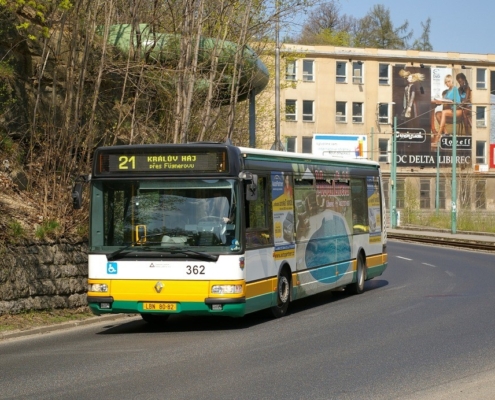
A noisy centre and a circular return
After crossing the tram track and driving around the well-known house now dominated by the Chicago restaurant, the space opens up further and the Fügnerova public transport terminal appears. We pull in to it past several important buildings — the labour office, behind which the S-tower sticks up, the parking house and the Fórum and Delta department stores. These replaced the well-known Ještěd department store, whose loss some cannot bear to this day. After extricating ourselves from Fügnerka, we set off along another of Liberec's traffic arteries towards Šaldovo náměstí. It is lined mostly with taller apartment houses, but also, for example, with the complex of the former Liberec printing works. As soon as we pass the Liberec chateau by literally centimetres, a large open space opens up with two traffic-light junctions, the Plaza shopping centre, the Hotel Liberec, the Zlatý Lev grand hotel, the majestic savings-bank building and other important buildings. At the upper traffic-light junction, which is none other than the most complicated junction in Liberec, we wait a good few dozen seconds for the green arrow and, past the Hotel Liberec, pull in to the out-of-the-way Šaldovo náměstí stop. This stop is fairly far from the stop of most other lines, which is on the tram track-bed. Although they have the same name (they did not always, though), the journey between them can even take several minutes. The junction is notorious for its peculiar function at night, when, as a tram or bus passes from the Plaza, the whole junction gets a red light, including the directions that do not cross it at all. This causes the races of the evening collective departure from Fügnerova at 22:40 and 23:10, when the colleagues from lines 15, 19 and 21 try to be at the junction before the others, because otherwise they will be left standing there for several minutes quite needlessly. Beyond the stop we pass under the hospital complex, which awaits extensive alterations soon, and appear by one of the many university buildings around the city. By the Poliklinika stop we discover, for example, the former Sokol hall with the popular pub Depo, or the old villas of notable Liberec citizens. We drive straight through the next traffic-light junction. It is surprising that only line 21 and a few line 35 services pass through this section of Jablonecká street. Along the traffic-light junction we pass the interesting shabby building of the textile secondary technical school, and above the trees we can also glimpse the significant building of the Ursuline convent with the polyclinic and the Church of the Sacred Heart of the Lord. Past a little park and the Liebig villa, we drop between two tall industrial buildings, by which we appear again at the traffic-light double junction by Textilana. After passing through it, we have to climb the steep hill back up to where we already know the way.