ROUTE FUNCTION
LIST OF STOPS
- 2 May 1978: the line was extended by the Gottwaldovo náměstí - Broumovská estate section, thus providing the first regular service to the newly built estate.
- 1979: the Gottwaldovo náměstí - Broumovská section was renumbered to line 25, and line 22 took over the original route of line 25. From this year the route is therefore as follows: Nikose Belojanise - Gottwaldovo náměstí - Pavlovice Letná - Pavlovice Tesla (today Pavlovice křižovatka). Between the centre and Letná, however, the line ran along tř. gen. Svobody (the route of today's line 24); the bridge between Pavlovice and Růžodol did not yet exist. Selected services were extended all the way to Tesla as a reinforcement of line 12.
- January 1982: the line is extended at both ends of the route at once. In Pavlovice it is the Pavlovice Letná - Pavlovice stadión section, and on the other side the Nikose Belojanise - Plastimat (today's Banskobystrická) section. The services to Plastimat replaced special services for its employees running from the centre. The reason was to save diesel, the supply of which was a problem at the time. Only selected services were extended, of course. At the same time, selected services stopped serving Tesla. The line's route is thus Pavlovice stadion - Gottwaldovo náměstí - Nikose Belojanise - Plastimat.
- 1992: the line was extended by selected services from Plastimat all the way to the Škoda plant, today the České mládeže turning loop.
- 1 January 1996: the major optimisation of the route network also affected this line, with a rerouting on the section from Fügnerova to the Pavlovice stadium. Instead, the line begins to run to the Kunratická estate, and selected services later continue all the way to Novoplastik. The route thus takes on almost its present form: České mládeže - Plastimat - Americká - Fügnerova - Kunratická Luna - Novoplastik.
- 1 September 2003: the line was extended into the new Southern Industrial Zone.
- 1 September 2004: selected services were extended to Hypernova (today OC Nisa), by which the line definitively takes on its present form.
Line 22 is known for the number of its variants in its southern part. If the driver has a terminus/starting stop beyond Americká, it is always necessary to make sure whether it calls at České mládeže or runs into the industrial zone. This section is also peculiar in its occupancy. Around shift-change times the bus may be packed to bursting, whereas at other times not so many people travel here. Let us first drive the longest variant of the route with all detours. It was driven with an Iveco Urbanway #718 in summer, after rain and before rain.
Now back again, but a slightly shorter variant. The continuation to OC Nisa is, I believe, clear from the other videos.
For good measure we will also drive the variant without detours, starting at Mšenská and ending all the way at OC Nisa.
And back again, but only to Kunratická sídliště. Here it is important to notice that Kunratická sídliště is driven differently if it is the terminus and differently if the service continues to Mšenská. It was filmed with a Mercedes-Benz Citaro #434 on a beautiful winter day.
Finally, one special service of line 22 and the bogeyman of new drivers. This service is the only one that starts at the Liplastec stop in the southern industrial zone area (Newtonova street). The stop lies off the line's route, so I filmed the video including the non-revenue run from the Průmyslová zóna Jih stop. This service is the only one that ends already at the Kubelíkova stop, and from there you have to get back to the Southern Industrial Zone. I left this run in the video too. I turned around right on Kubelíkova, but it is quite tight there. Some drivers therefore go to turn around at the nearby Dolní Hanychov tram terminus.
When I once told a friend that I drive line 22 today, he asked me: "Which of them?" With that he captured the character of this line, which is essentially two lines, connected only by part of the services. Together the line has many different termini, detours and route variants, which is why I have called it the most varied line.
Since it is practically two lines, I will unusually split this article into two non-connecting routes, always in the direction from Fügnerova. In practice the driver usually really does encounter a service starting/ending right at Fügnerova. First we will drive the shorter and at the same time busier section towards Kunratice.
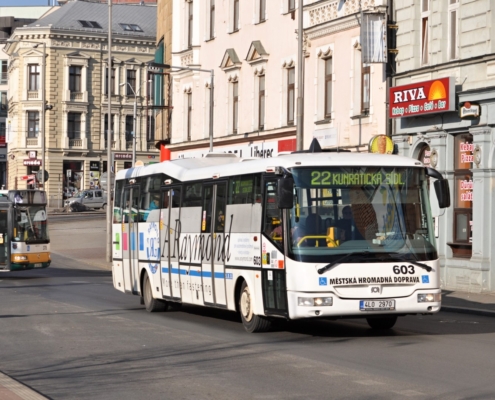
Past the former Textilana
Together with the 25, the most demanding way of extricating ourselves from the lower-centre area, where the Fügnerova terminal is, awaits us. First we set off past the OD Delta, where we have to wait until some kind driver lets us out of the terminal (it is odd that at peak such a one is always found very quickly, but at the weekend one can spend quite a while there) and, past the old OD Balon, where there used to be perhaps the first illuminated advertising board in Liberec, we head for the crossing over the tram track to Jablonec. Around the roundabout we drive past the well-known house with the Chicago restaurant, but most people still call it Plaudit, after the original restaurant. Then we have to cross the tram track again and finally we can put our foot down a little. Na Bídě street awaits us, lined on one side by old houses that remember the old single-track line, which wove between development that no longer exists. On the other side tall panel blocks rise, above which more are visible on the little hill. Soon we have to drive around the former huge Textilana complex. As a memento a single half-ruined building has been left here; otherwise the area is to this day a kind of wasteland, or rather already a little wood that has grown on the remains of the old factory. As a child I remember the demolition and even the blasting of the chimney. A new use for this brownfield is, however, nowhere in sight. Across a traffic-light junction we reach, along a straight, the U Lomu junction. On the left, behind the trees, we see the beginning of the Králův Háj estate.
From the quarry towards the snow
The U Lomu junction is interesting, for instance, in that an offshoot of the tram track towards the Rochlice estate is sketched here, which was not and probably will not be built. But at that point we split off from the tram track to Jablonec and turn left towards the hairpins of an overgrown little hill. We pass only a few sets of garages and, of course, the stone quarry. Above the little wood some panel blocks are visible, but we reach the development only beyond the Ječná stop. First older villas honour us, but soon the Kunratická estate appears, a petrol station, a shop, a sports centre with minigolf and other service buildings. Even the Východní stop is right in front of a bakery. In winter you can tell we are more than 50 m higher than in the centre. There tends to be a little more snow here than down below.
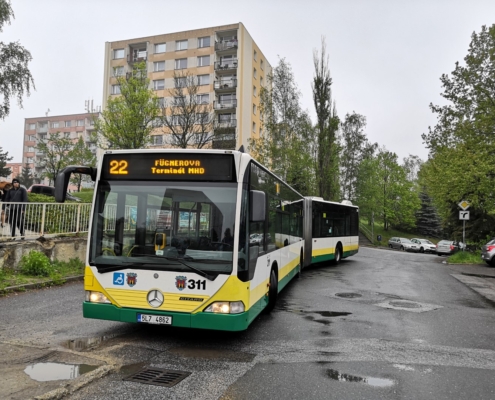
The faded glory of Luna
For most services it now only remains to reach Luna, past another small wood — a classic socialist service centre that was not missing on any housing estate. Luna's glory is, however, long gone; it is now a dilapidated, unsightly building with a few small shops and services. Whenever I enter that emptied grey cube, a strange chill takes hold of me, and I am always glad when I leave it. As is usual in Liberec, the terminus is rather on the edge of the whole estate, and to some panel blocks one still has to walk a fair way.
To Novoplast
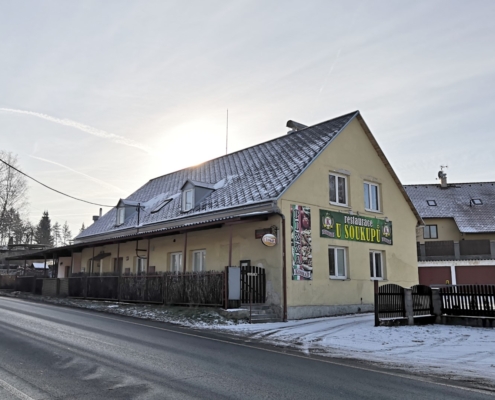
The services that continue further have to reach Luna from the opposite side, so they turn off a little earlier, into the street along which all services run to the centre. After unloading passengers at Luna, usually only a few people remain on the bus, if anyone at all. Leaving the estate is sometimes demanding; the traffic density on the main road is high and the entry onto it is accompanied by a fairly steep break, so one has to drive slowly and carefully. We pass more garages, the former U Soukupů restaurant, a meadow where people walk their dogs, a substation and a garden centre, next to which there tends to be a giant pile of soil. The roundabout throws us onto road I/14 towards Jablonec, by which we de facto leave Liberec. It is one of the few sections in the Liberec transit network where we can legally take the bus up to its maximum speed. We pass a few small houses, gardens, but also meadows on which there may soon be a new housing estate. The ride ends at the first turn-off to the left, where the Novoplast plant is, which develops plastic products. Apart from a few people from the surrounding houses, this plant forms the only, but surge, passenger frequency on this section.
Past the Babylon to the railway station
From the terminal we set out through the parking house adjoining the OC Fórum, along the one-way Blažkova street and then Náchodská. I remember the time when these streets were used only as a replacement route in case it was not possible to turn from the terminal into the then two-way Dr. Milady Horákové street. Now both streets are used, one there and the other back. A view awaits us of the tall regional-authority building, the little park with a future riverside walk and, behind it, the IQ Landia building visible through the trees. Right after that we appear at the busy junction with Košická street, into which we also turn. It is precisely this junction that causes the long queues leading to the slip road off the through route and sometimes all the way to the railway station. Along Košická, besides the building of a dubious hostel with an unsightly car park, there is the well-known Babylon Culture, Shopping and Social Centre, which arose from the ruins of the old Hedva works. It was certainly better known and unique rather in the 1990s and at the turn of the millennium, however; now its spaces have an aftertaste of faded glory. Even the stop next to the building has been a request stop since 2019, which tells you something. We pass under the city through route, road I/35, and emerge onto a long straight running alongside buildings formerly belonging to the railway station. Today in them we find, for example, a popular café, offices or a post office. Catering establishments are found also at the place where the majestic customs-house building once stood. That is right opposite today's station hall. In front of it we have to overcome a complicated junction with the tram track, which also usually causes congestion at peak. With that we briefly join the tram track-bed.
An insensitively placed estate and the oldest Liberec house
Beyond the Nádraží stop we descend Žitavská street down the little hill, where on the left we have the northern throat of the station and on the right the bus station of suburban and long-distance transport. The tram track branches off at the place where the Sofia cinema used to be, and we join the queue at the large double junction called "u viaduktu" (by the viaduct). The whole place underwent an enormous transformation because of the construction of road I/35, for which many houses fell. Today it is probably the second most complicated junction, right after the Šalďák. Long queues often form here too. The tall railway viaduct rises above Hanychovská and Švermova streets, into which we turn. It takes us into the Františkov district. The village character was broken under the former regime by the placement of several panel blocks right among the houses and villas. Nearby, moreover, we find the very oldest house in Liberec, built in the second half of the 17th century. Opposite SVED we turn left into Uralská street, by which we leave the route shared with line 16 and the route of line 22 heads south.
A former abattoir and the horizon
The short and narrow Uralská street takes us, past a few houses, to the first detour — the detour to Americká. Under the former regime, however, this street and stop were of course named differently, after the Greek communist Nikos Beloyannis. Americká street runs through a strange mixture of older and newer apartment blocks and large old yards. The yards with dilapidated large houses recall the original use of this place, to which the original name of the Domažlická stop also testifies, as it was called U Jatek (By the Abattoir) until 2010. At the Americká loop, which is at the same time the car park of the adjacent house, some services end. The others, however, just turn around and head back to Uralská street, onto which Kubelíkova follows. The occupancy of this part of the route depends on the time of day. If it is the bringing-in of passengers for a shift change, the buses tend to be very busy; at other times they may be almost empty and fill up only on the way back. We have to drive around several older villas, behind which smaller industrial buildings are hidden. The change comes with a sharp bridge crossing the railway to Česká Lípa. From it we can briefly glimpse the strange, now needlessly large Horní Růžodol station. Beyond the bridge the villas slowly begin to give way to the panel blocks of the Gagarinova estate, and we appear at the "U Horizontu" junction. The name derives from the adjacent functionalist service centre for the local typical socialist housing estate. The centre ended up like most of the others — a dilapidated building with a non-stop shop, a second-hand shop and one little grocery, where time has stood still. At the traffic-light junction we cross at a right angle with the city tram track and continue towards a large industrial district. It begins as soon as we leave the last panel blocks and villas. It is interesting that the Gagarinova estate is not very noticeable on the map precisely because it is surrounded on all sides by other development.
An industrial zone, a shopping zone and detours
The industrial zone is a journey from older history to newer. It begins with the former, now modernised building of Plastimat, today Magna International. The local industry grew up back in the 1980s. The older buildings we can still glimpse rather on the right of the route. It is to this zone, after all, that selected services head via the first exit from the roundabout. The roundabout, which forms the junction of České mládeže, Kubelíkova and Průmyslová streets, also functions as a kind of lottery drum that decides the further route of our service. Three exits equal three route variants along which the 22 can continue. We, of course, will drive them all, so we take the very first exit. It must be said that today there are markedly fewer services running towards the České mládeže loop than before. The first services here began in the 1990s to the Škoda works. Today many smaller and larger companies are based in the area. As it is again only a detour, we have to return to the roundabout. The second exit takes us into the new industrial zone, built gradually since 2003. In the place where I remember extensive fields and meadows, we now meet only a heap of grey boxes.
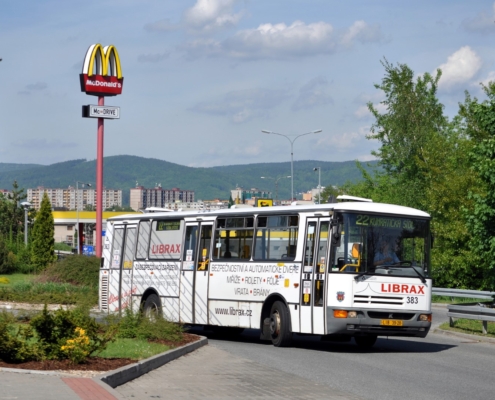
Yet this place has a certain poetry too, and it concerns the daily rhythm. From the very beginning it fascinated me that for most of the day the whole zone is fairly calm. Before a shift change, however, the traffic begins to grow noticeably. The best time to observe this is around 2 p.m., at the changeover of the morning shift for the afternoon one. Already from 13:15 the traffic thickens and the first buses begin to arrive. By 13:45 only the last latecomers are arriving and the lay-by areas are overflowing with waiting buses. At 13:55 absolute calm reigns in the zone. At 14:00 the doors burst open and crowds of people begin to stream out of the halls. At 14:15 there is life everywhere, buses depart and a queue begins to form at the exit from the zone. At 14:30 the queue still holds, but around the halls it is once again completely calm. Most line 22 services end here. Some, however, return to the roundabout and continue further. But there are also those that serve neither České mládeže nor the industrial zone and go straight to the third exit. Along České mládeže street, quickly past Magna and the noise barrier, we reach another roundabout. Few people suspect that behind the noise barrier a small residential zone is hidden, which remained as a relic of the original character of this landscape before industry and traffic took it over. We barely notice that we also cross the railway towards Turnov by a bridge. Beyond the roundabout, though, it is clear: we have reached, for a change, the shopping zone, dominated by OC Nisa. We stop at the upper entrance opposite the multiplex and, past the car-parking areas, weave all the way to the terminus by the lower entrances to the shopping centre and the first McDonald's in Liberec. It is a busy place, because right next to it runs the main city through route. We often meet here the commercial line 500, which arrives precisely along the through route. Here this long journey ends. If we set out from Kunratická and have all the detours behind us, we have driven one of the longest services in the Liberec transit network.