ROUTE FUNCTION
LIST OF STOPS
- 1986: the line was extended to the site of today's Krejčího stop, which then received precisely this name, and later all the way to the Zelené Údolí loop. Selected services began to serve the Československo sovětského přátelství Broumovská estate, where it already supplements line 25 at that time. An 8-minute interval was introduced at peak.
- 1988: the peak interval was shortened to 6 minutes.
- 1989: the interval was shortened to as little as 5 minutes.
- 1 January 1996: after the major optimisation of the route network, the line was extended at the northern end all the way to the Růžodol mlýn stop (or rather merged with the former line 31). Selected services continue to Stráž nad Nisou, others from Růžodol I along road no. 35 to the Elitex plant, and some even to Pavlovice, to Letná. At this time it was an ordinary line operating most of the day and at weekends, when it ran as the only service to Stráž nad Nisou. Gradually its importance declined in favour of lines 12 and 30, until it became a stub of just a few services.
- 2006: in this year (until 1 September) the line is in operation all day and at weekends for the last time.
- 1 September 2006: from this date the line is reduced to roughly its present form. With that, the regular use of the Růžodol Mlýn loop also ended for more than 15 years. Only from 12 December 2021 is it used again, by the weekend line 39.
- 2008: the Elitex plant closes, and with it the special express services to this plant. They originally ran directly from Růžodol I to Elitex, and later were operated as services ending at the Stráž nad Nisou elektrárna stop.
- 2 March 2026: the evening services are shortened to the Fügnerova - Stráž nad Nisou section only, so a single morning service Pekárny - Stráž nad Nisou remains on the full route.
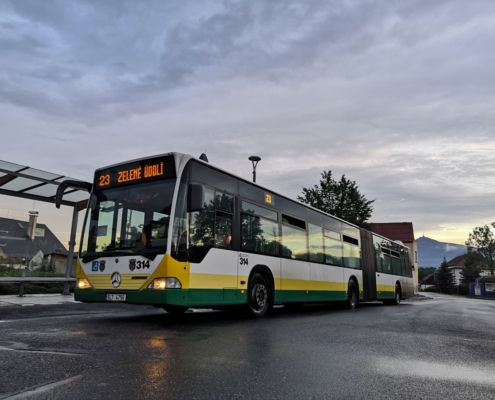
Line 23 is now a peculiar remnant of a once ordinary line. On the Zelené Údolí - Růžodol I section it is no different from line 12, and on the remaining section, in turn, from line 30. The evening services tend to be completely empty, yet articulated vehicles are deployed on them as a run-on from line 12. For the morning services, usage depends on the specific service and on whether school is in session. The connection of Stráž and Zelené Údolí itself, however, no longer makes any sense today, which the drivers are aware of too. In the footage you can see an evening service at summer dusk with an articulated Mercedes-Benz Citaro #316 towards Stráž. On the way back we travel with an Iveco Urbanway #534, on a fairly busy morning service all the way to the Liberec bakeries (Pekárny).
I have strange feelings when I drive the evening line 23 with an articulated bus and carry barely a few people from Fügnerova to Stráž. It makes no sense at all; it is just a relic of times past. After many years of cutbacks, it is as if no one wanted to be the last to abolish the line for good.
From the church to the wastewater treatment plant
The journey begins by the Church of St Catherine, which adjoins Bergrovo náměstí, which forms a kind of main square of the village of Stráž nad Nisou. Around it we find the Formanka restaurant, an open-air cinema and a sports ground. Although Stráž is structurally connected with Liberec, de iure it is an independent village. The square is driven one-way towards the church and thus forms a large turning loop. After leaving this "loop" we find ourselves on Studánecká street, along which we head downhill to the former power station. That is today recalled only by the name of the next stop and the adjacent street. A new power station was built a little further down the flow of the Lužická Nisa river. On the way downhill we pass villas, but also inconspicuous small cube-shaped panel blocks. By the power station we join the flow of the Lužická Nisa, but also road I/35, which forms the city through route. Both lines will stay with us for some time. Even before the confluence with the Černá Nisa, a passage through the grounds of the Benteler company awaits us. Interestingly, in front of the grounds there are traffic lights on both sides that stop the traffic in case a lorry is being manoeuvred in the grounds. We can thus easily pick up a delay right at the start of the route, but the driver encounters this only rarely. After passing through the grounds we can hear a strange metallic rumble. That may be a train passing above us over the viaduct of the railway towards Frýdlant. We drive around the mentioned confluence and the industrial complex and, at the junction, join Oblouková street, which later changes into Londýnská. Here our route briefly meets line 28. A fairly long section through no-man's-land awaits us. As far as the "U Totalu" roundabout we see, on the left, only an embankment with the four-lane road I/35, on the right then a few houses, the grounds of the wastewater treatment plant and a few shops. We also pass the Růžodol Mlýn loop, where many line 12 and 23 services used to turn around. Between 2006 and 2021, however, it was used only exceptionally and for most of the time stood empty. Today the weekend line 39 turns around on it.
In the footsteps of the tram route
"U Totalu" is still the name given to the roundabout that links up with the whole complex of roundabouts called the snowman. Total was once the name of the old adjacent petrol station. Since then its operator has changed several times, but the name has stuck. Beyond the roundabout comes the area called Růžodol I. Here, long ago, the second tram route in Liberec ended, but today nothing recalls it. We will follow its trace all the way to the centre. Surge demand here is taken care of by students of the F. X. Šalda Grammar School. That is fairly far away, but line 14, which runs closer to it, runs too infrequently to be good service. From now on we also follow the route of line 12, which, unlike the 23, runs regularly all day. Then comes the S-bend of Londýnská street past old villas, and the line emerges onto another bridge over the Nisa. Besides the Lužická Nisa we also cross the well-known cycle path. The problem is that it crosses it on the level, so the driver is not pleased when a cyclist, late in the evening with empty roads on a clearly visible section, calls up a green light, and the poor souls on the bus thus have to wait. But never mind; through ever-denser development we finally reach the historic centre of old Liberec.
Through the centre of old Reichenberg
Today the hub of activity is a little further on, but every Liberec local knows that we are passing places where it all began long ago. The historic centre begins with the Church of the Finding of the Holy Cross, built on the site of a plague burial ground. It was the second church in Liberec. Then we have to weave through a narrow little street between tall houses, where a bus and a car barely fit (the cars usually do not mind, though, and try to give us a bit of a hard time). After passing through this dark little street, a light-filled square suddenly appears, which could also tell many a tale. It was precisely around this square that old Reichenberg once arose. So it is no coincidence that on one side it adjoins the oldest standing houses in Liberec — the Wallenstein houses — and on the other the oldest church in Liberec, the Church of St Anthony, dating perhaps from 1579. Right by it the street narrows again into the built-up area, and just a few metres further we pass the corner of today's hub of activity, namely náměstí Dr. Edvarda Beneše and, opposite, the Liberec City Hall. There remains a stop right between two of the most beautiful buildings in Liberec — the Vienna-style town hall and the F. X. Šalda Theatre — and it is already time to join one of Liberec's traffic arteries, Sokolská street. Getting from the historic centre onto this artery is sometimes a tough nut too. One thing is the frequent queues, another the complicated turn with a lack of space. The turn in the dense development is so sharp that the bus always has to go briefly across the oncoming lane. So at a place where queues often form, the bus has to let cars through from both sides, even though it is turning right. After a moment the development throws us out onto the largest and most complicated junction, Šaldovo náměstí, and at once we find ourselves by a product of modern times — the Plaza shopping centre. From the Šalďák we descend a few hundred metres along the cramped Rumunská street to the Fügnerova terminal, where a big exchange of passengers takes place.
By a small line to the largest estate
At first glance it would seem that the text could be the same as for line 12. That, however, is not so. The lines have the same route, but a completely different character. The 12 is a trunk line that, from this moment on, is always full. The 23 runs only early in the morning and late in the evening, so this is far from always the case for it. Those times used to exist, but they are now history. The same applies to the termini. The 23 too used to end at Zelené Údolí, at Broumovská and at Pekárny. Today all services end at Zelené Údolí, with the exception of one that continues to Pekárny. But something tells me that its time too is drawing near. The journey continues through a not very interesting part of the centre with older houses, here and there a tower block, and gradually scrapyards, a petrol station and the incinerator, originally placed in the city centre. Only beyond it do we turn into a denser district of medium-sized apartment houses and fairly narrow streets, to soon emerge at the edge of the largest estate, Rochlice, built in the 1970s, which moreover grew further after 2000 with adjoining modern development and is still growing to this day. The largest share of passengers gets off at the Dobiášova stop, adjoined by a primary school specialising in physical education.
As I have already mentioned, most services end at the end of the estate, at the Zelené Údolí terminus. The last terminus, with its glory already faded, is Pekárny. The terminus lies, as the name suggests, in a little wood by the Liberec bakeries, just a few hundred metres beyond the Zelené Údolí loop. Today only one service of this line comes here early in the morning, and a few line 12 services, which are, however, dwindling. Often they go unused, so who knows how long this terminus will still appear in the timetables.