ROUTE FUNCTION
LIST OF STOPS
- 1986: the passage through the Liberec air-handling works (LVZ) ends and the line is permanently rerouted into Slovanská street, as we know it today. A new stop, U Modelárny (today Na Srázu), is also created. At the same time the line is extended all the way to the Doubí sídliště terminus, where a new estate is being built, and thus supplements line 20.
- 1990: after the major optimisation of the route network, the line is extended all the way to the Pavlovice, Tesla loop.
- 1992: due to the plant's poor economic situation, selected services are, until the end of 1995, extended to the outlying districts instead of the services of lines 13, 26 and 28. This was de facto a foretaste of the new three-line system. Only line 24's service to Radčice in the late-morning hours and at weekends all day has remained to this day.
- 1 January 1996: lines 13 and 26 are extended to Doubí along the same route, and line 24 thus becomes, for most of its route, part of the three-line group 13, 24, 26.
- 2015: the last service that turned around already at the Radčice rozcestí stop was abolished. Earlier there were several such services, especially in the late-evening hours. For the last three years only one morning service had survived. These services are the reason why, in the direction towards the centre, two posts of the Radčice rozcestí stop still stand to this day — one before the junction, the other after it.
- 30 September 2024: after the reconstruction of Sokolská street, the Sokolská most stop was abolished and a Sokolská stop was introduced in the direction from the centre at the site of the original suburban-transport stop.
In its most common variant, Doubí sídliště - Pavlovice křižovatka, line 24 is not a demanding line in terms of route. It mostly takes place on easily passable main roads. It is more demanding on the timetable. Because of its length and the fact that it crosses a busy railway, many traffic-light junctions and the very centre, delays arise easily. Even a small delay, given the high passenger frequency and the short interval, causes services to bunch up frequently and high occupancy.
The Pavlovice křižovatka - Radčice section, which only selected services serve, is in turn one of the most demanding in terms of space. All the streets, from Polední to Raspenavská, are just wide enough for a bus. The timetable and route (which differs there and back) fortunately take this into account, so it is impossible to meet a colleague with another bus. That does not mean, however, that an encounter with an ordinary car in the wrong place cannot cause trouble. The most dreaded are above all Polední, V Rokli and the second part of Výletní streets. And now imagine meeting a snowplough at these spots in winter... The section is very demanding but one of the most beautiful, so we will start the driver's view right here, with the now retired Tedom C12G #518.
From Doubí to Radčice we travel a year later, but a little earlier in spring (in Radčice you can still see the remnants of snow), with an Irisbus Citelis #704.
First, the Pavlovice křižovatka - Radčice section will be described, which is unique and specific to this line. The Doubí sídliště - Pavlovice křižovatka section is shared with lines 13 and 26 and is therefore described in the second part of the text.
The section begins at the large Pavlovice křižovatka loop, where most of the line's services end. To this day locals call the place either "the junction" (křižovatka) or "u Litesu" (by Lites). Right next to the loop stands the architecturally significant factory building of the Siegmund brothers, with a rich history, which later became the seat of the Lites company, which still makes fire-safety equipment today. Indeed, the loop too used to be called Pavlovice Lites. An important crossroads, however, had been here long before Lites. We must not forget the Staročeská restaurant, well known throughout the wider area, though hardly any local calls it anything but "Na kříži" (At the Cross). It is right in front of it that the services not ending at the loop turn off to their separate stop. Opposite the stop is the former villa of the Siegmund industrialists, around which there used to be a landscaped park where I spent many hours in childhood and later. The old landscaped park from the days of the Siegmund industrialists is now noticeable only on an attentive walk through the wood. In it you will find old fence posts, ornamental trees that do not belong in a Czech wood, and even the foundations of gazebos and a swimming pool! On the top of the hill above the park there then stood, until the Second World War, the Siegmund lookout tower. Even after it, we find the remains of its footings there.
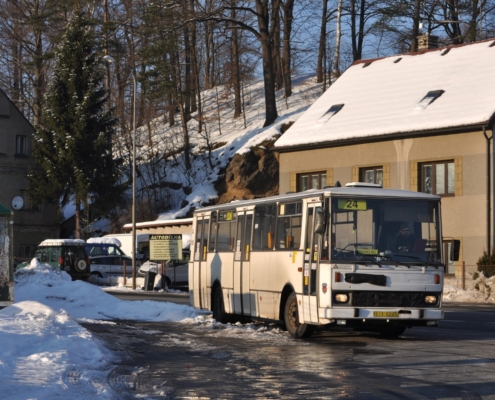
Through the valley of the Černá Nisa
But let us continue along the route of the 24. For now it does not continue entirely alone, because line 28 and line 13 services run here too. Before you know it, the surrounding world changes completely. From the trunk road on which the 13 arrived from the city, you find yourself on a smaller road in a fairly deep mixed forest in the valley of the Černá Nisa river. On the left a steep slope, rocks and trees, on the right the riverbed. Apart from a few warehouses and ruins, the route does without civilisation for a long time. Although the valley is deep and the sun reaches it only rarely, the banks of the Černá Nisa here were a popular recreation spot. This is proven by the fact that they were once nicknamed the Adriatic (Jadran). Today you would hardly see anyone sunbathing there, but the place is still considered an interesting tourist destination. After this wooded section we reach Janův Most. Here the first houses and old factories appear, which made use of the swift flow of the little river. Discovering them, however, we will leave to line 13, which continues along the valley, whereas the 24 now has to turn right and extricate itself from the valley. We now share the route only with line 28, and it will stay that way to the terminus.
Places barely fit for a bus
Polední street is among the narrowest places a bus has to squeeze through in Liberec. The gentle hairpins in the dense forest are, however, at the same time among the most beautiful sections, where you may meet, for example, wildlife running across. A collision, though, is not much of a threat, because the bus's speed is low. Every driver fears a car suddenly tearing out of a blind bend, so they drive at walking pace. Only when, beyond the last bend, the light of the adjacent meadows appears, is it won. We have emerged at the junction with Výletní street on an inconspicuous ridge, where the name of the stop recalls an ancient crossroads. But the last kilometre to the destination still awaits us.
Around Jedlová
The remaining section is still characterised by narrow little streets that cross every which way, as the village once grew. A novice driver has to be very careful to turn into the right one. The scenery of sparsely scattered houses among fields and groves resembles a sub-mountain village. On the way back, in suitable conditions, there is a beautiful view of Liberec and the Ještěd–Kozákov ridge on this section. By the Jedlová stop we can recall the old school or the well-known former inn Na Jedlové. At the junction of five streets only a small shop, U Kozejů, remains to this day, where in suitable weather the locals often stand with bottles and look over every bus like an attraction. In a moment we finally reach the highest point of the route, which is at the same time the terminus. It is right next to the wooded Dračí vrch hill with the stone lookout Na Dračím kameni (On the Dragon Stone). It is a popular destination for tourists, so in good weather the bus brings a few of them; at other times, however, it often runs almost or completely empty.
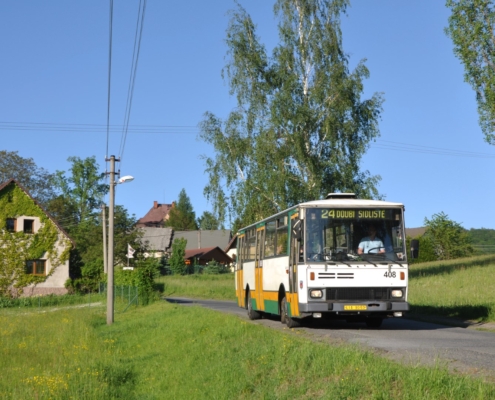
Back a different way
In this case it is worth musing over the return route too, which from the Radčice rozcestí stop is different. It has been so since the first line to Radčice was introduced. The line thus, on the one hand, serves more places, and on the other hand it eliminates the risk of two buses meeting at some narrow spot. And so we enjoy the beautiful view once more; perhaps we will be lucky with a summer daybreak early in the morning, when we have the awakening Liberec in the palm of our hand and Ještěd awaits the sunrise, during which it turns dark red shades. Beyond the crossroads we do not turn left, where we came from, but continue straight. First gently uphill, then downhill. The character does not change much for now; we still pass now an older house, now a newer one, now a meadow with a grazing flock of sheep. Gradually, however, the development thickens and Výletní street becomes more cramped and twisting. After crossing the little bridge over the Radčický brook, we find ourselves at the one-way U Lípy stop, which is already in the territory of Krásná Studánka. From here it is just a short way to the main Hejnická road heading to Mníšek and on into the Frýdlant spur. At the same time, here we join line 26. Through the wooded valley we whizz past the sunken building of the former Textilana, which is still in use today, and beyond a sharp bend a large area with a loop already opens up to us — we are again in Pavlovice, at the junction, although the loop itself is in Stráž nad Nisou.
The three-line group made up of lines 13, 24 and 26, which share most of their route, is unquestionably my greatest "favourite". From an early age I rode it from Doubí to Pavlovice to visit my grandmothers. Later in childhood and adolescence I rode it daily to ZŠ Vrchlického, then to grammar school, to pubs, to the authorities, on trips, to the Prague bus for university, and so on as life went on. So I mainly used the part between Doubí and the centre, but occasional trips to Pavlovice and other parts continued. And today I am part of it again, but no longer so much as a passenger, rather as a driver. On today's shift, in fact, I have one round to Radčice, two to Krásná Studánka and the last all the way to Stráž ahead of me. So it can be said that this three-line group has become, in its so-far unchanged form, an unshakeable part of my life. It has been so for almost 30 years. I know every house here, every hole in the road. I know, and have often seen, how various buildings have come and gone along the route over time, as the city constantly changes. If I were to write down all these memories, it would fill a whole book about a single bus line. In this article, of course, I will be more concise.
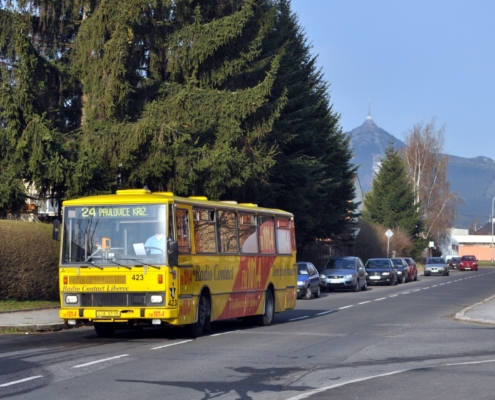
Insensitively placed housing estates
The southern end of the route serves two Liberec estates, Doubí and Vesec. There the route is characterised by a dense network of stops. Although Vesec and Doubí used to be small picturesque villages just outside Liberec, old original houses are now few in these locations, and most of them lie further from the bus route. The village character full of meadows and fields was changed in the last century by giant concrete colossi — panel blocks built on extensive green meadows. We drive around the Doubí estate on its southern side, opposite which we find smaller terraced houses. Beyond the traffic-light junction, where there used to be trees, we also pass a relatively new football pitch, which, however, is already in the Vesec cadastre. By the roundabout we pass an old, now barely noticeable bus turning loop and drive past the majestic Vesec school with its Sokol hall, which still recall the old days of quality architecture. A little further on, however, panel blocks begin on the right, on the left there is still an old post office with a shop, and beyond that older and newer villas. But these last only a moment, and soon more giant "rabbit hutches" appear on the left. On the right the long-dilapidated building of the Libena factory is worth mentioning. After leaving the estate we descend a steep hill past a timber shop that I remember there from childhood. Below the hill comes a passage through a once-whole, now divided and modern industrial plant. After a sharp bend, with a small ghetto on one side and a former pub and gym on the other, we reach a level crossing that separates the next stage of the route.
Through the valley of the Lužická Nisa
The level crossing can hand out a delay of several minutes too. Right beyond it we enter Poštovní náměstí, where the first tram route in Liberec once ended, and a bus line ended here too. Now, however, no one would even think of it; the square changed beyond recognition around the new millennium. It is characterised rather by the fact that part of it is hidden under the flyover of the Liberec–Jablonec expressway. Another peculiar characteristic of this square is that on it and in the immediate surroundings there are about 4 non-stop bars/gambling halls. I never figured out why they concentrate right there; I never saw a large number of people in them, but they have survived there for years. On this square our three-line group also joins lines 20 and 37 and continues with them to the centre along Dr. Milady Horákové street. It is lined on both sides by older houses with various services, behind which, on the left, the Nisa river is hidden, on the right more houses and, right next to them, a rock massif on top of which the edge of the Rochlice estate is visible. The houses are occasionally replaced by various facilities, such as the Kaufland store built on a former factory. Other old factories in the Nisa valley did not get demolished and were rebuilt. Beyond the Čechova stop the main landmarks are the law school and the Liberec heating plant and incinerator. The houses on the right grow larger, but only up to the next traffic-light junction by the Melantrichova stop. On the right it is lined by a strange no-man's wood before we reach a petrol station and more villas. On the left various industrial facilities continue.
The busy city centre
The junction with Košická street, in my eyes, separates another stage — the stage of the centre. For now we still skirt a little park and more villas, but soon we reach the tall buildings of the regional authority, the S-tower, the labour office and others, which mark the approaching Fügnerova public transport terminal. Suddenly we find ourselves in the lower centre of the city, full of shops, restaurants and the Fórum and Delta department stores. Those who remember will recall the old Ještěd department store, which had its die-hard supporters and opponents. As we extricate ourselves from this airy space, we find ourselves in the somewhat darker 8. března street, lined with fairly tall old apartment houses. Soon, however, we pass the Liberec little chateau and suddenly find ourselves in another airy space dominated by the Plaza shopping centre and the largest Liberec junction, Šaldovo náměstí. With the bus we split off onto a dedicated road shared with other lines, including tram lines, which directly adjoins the Plaza. After overcoming the Šalďák, we again plunge into a narrow dark street between tall houses that remember much. One of them is the old post office, still the main Liberec post office today. We briefly glimpse the F. X. Šalda Theatre and the town hall, but quickly disappear at the stop under the bridge on Sokolská street. Beyond it we can again briefly glimpse the modern regional research library and, downhill, leave the city centre at greater speed.
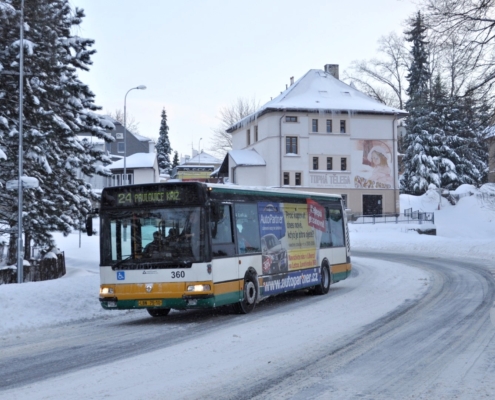
The calmer part of the route
At the next traffic-light junction we turn left and the character of the city changes again. The rest of the route follows a road hundreds of years old into the northern corners of Bohemia. At peak it tends to be fairly busy, but on quiet evenings it can be driven the whole way without stopping. In general this half of the route is much calmer than the first part. We pass a small theatre and find ourselves on a neat straight street that blossoms beautifully pink in spring. We pass a mixture of villas and modern houses with services. Behind them we can only sense an interesting youth hostel with a rich history and architecture resembling a chateau, and a little further the Jedlička Institute by a beautiful villa district. But already we descend a sharp S-bend to the traffic playground and, opposite, glimpse the main football stadium. Dopravní hřiště (the traffic playground) is also the name of the adjacent stop, at which it does not often stop, but during a football match there can be downright crowds here. After the S-bend descent, though, we have to climb back up the hill again. We pass, among other things, a former hotel, now the Atrium retirement home. When we climb the hill to the Vrchlického stop, the strange socialist department store Merkur appears on the right. It was from here that I, with many other pupils, walked to ZŠ Vrchlického, though some also to the adjacent ZŠ Sokolovská and the Podještědí Grammar School. Beyond the next bend follows a straight with a vet's, a strange casino, and it ends with a very sharp bend, beside which stands the building of the Universum International Centre, otherwise also called the Colosseum. For decades now, cultural and educational events, among others, have been held here. Beyond the bend we soon reach the Hrdinů stop, where there is the well-known pub Václavka and a building where various services come and go over time. Up the next hill we already drive through a little wood that somewhat darkens the whole street. Beyond the wood, however, the Nové Pavlovice estate and the adjacent garages peek out. On the hill by the Letná stop there used to be a classic estate corner shop. Now motorbikes and quad bikes are sold there. The shop was replaced by a Billa supermarket opposite. But even that did not last and turned, after a few years, into an industrial building. Ahead of us is only the steep descent through an overgrown valley to the Pavlovice junction, during which we glimpse the Nové Pavlovice estate on the left and, on the right, a notorious house with notorious residents. With that this account ends. The area of the Pavlovice křižovatka loop is the terminus of the larger part of line 24 services, but it is also a place with an immensely rich history, which you could discover in the account of the remaining parts of the route of lines 13, 24 and 26, which branch here and each continue elsewhere.