ROUTE FUNCTION
LIST OF STOPS
- Doubí sídliště
- Mařanova
- Vesec U Střediska
- Vesec samoobsluha
- Jeřmanická
- Slovanská
- Rochlice
- Mostecká
- Čechova
- Melantrichova
- Košická
- Fügnerova
- Šaldovo náměstí
- Sokolská
- U Dvora
- Dopravní hřiště
- Vrchlického
- Hrdinů
- Letná
- Pavlovice křižovatka
- U Radčického potoka
- Kr. Studánka kovárna
- Kr. Studánka Švestková
- Krásná Studánka
- Na Vršku
- Stráž nad Nisou
- Stráž nad Nisou
- Na Vršku
- Krásná Studánka
- Kr. Studánka Švestková
- Kr. Studánka kovárna
- U Radčického potoka
- Pavlovice křižovatka
- Letná
- Hrdinů
- Vrchlického
- Dopravní hřiště
- U Dvora
- Sokolská
- Šaldovo náměstí
- Fügnerova
- Košická
- Melantrichova
- Čechova
- Mostecká
- Rochlice
- Slovanská
- Na Srázu
- Jeřmanická
- Vesec samoobsluha
- Vesec U Střediska
- Mařanova
- Doubí sídliště
- 1982: selected services continue all the way to Stráž nad Nisou.
- 1 September 1990: after the major optimisation of the route network, line 26 is run as a circular line on the route FÜGNEROVA - Krásná Studánka - Stráž nad Nisou - Růžodol I - Nádraží - FÜGNEROVA. After two months, however, it is split and returns to the original route. Line 30 is created from the remaining section.
- 1992: the line was temporarily discontinued between February and October due to the company's poor economic situation, with the services to Krásná Studánka replaced by line 24. After the line returned to service, several services (especially at weekends) still remained, operated by line 24. This was de facto a foretaste of the new three-line system 13, 24, 26.
- 1 January 1996: after the major optimisation of the route network, the line was extended all the way to Doubí sídliště along the route of lines 13 and 24, thus taking on its present form.
- 30 September 2024: after the reconstruction of Sokolská street, the Sokolská most stop was abolished and a Sokolská stop was introduced in the direction from the centre at the site of the original suburban-transport stop.
Line 26 is among the longest lines, most of which is part of the main three-line group Doubí sídliště - Pavlovice křižovatka. The problems of the section between Doubí and Pavlovice křižovatka are the same as for lines 13 and 24 — frequent delays and overcrowding of services at peaks; otherwise, however, it is a fairly relaxed section. The continuation to Krásná Studánka is also easy, as it runs directly along the nice new road no. 13 towards the Frýdlant region. Somewhat worse is the continuation to Stráž nad Nisou along the long and fairly narrow Studánecká street. This, however, concerns only a small number of services. Most of these extended services continue all the way from Krásná Studánka, but there are also services which do not call at the Krásná Studánka terminus and instead turn into Studánecká street straight from the Krásná Studánka Švestková stop. I filmed the round including Krásná Studánka with an Iveco Urbanway CNG #536. As a point of interest, I left in a diversion between the Košická and Fügnerova stops. You can watch the regular route on lines 12, 13, 20, 24 and others.
First, the Pavlovice křižovatka - Krásná Studánka and Krásná Studánka - Stráž nad Nisou sections will be described, which are unique and specific to this line. The Doubí sídliště - Pavlovice křižovatka section is shared with lines 13 and 24 and is therefore described in the second part of the text.
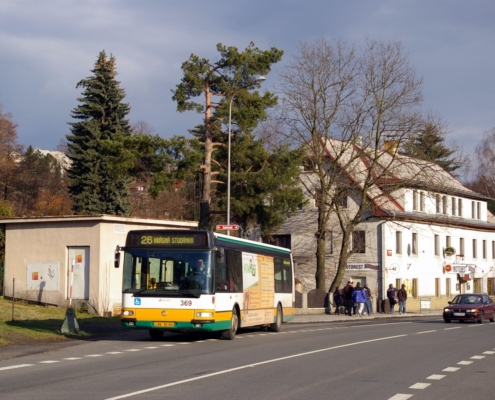
The section begins at the large Pavlovice křižovatka loop, where most of the line's services end. To this day locals call the place either "the junction" (křižovatka) or "u Litesu" (by Lites). Right next to the loop stands the architecturally significant factory building of the Siegmund brothers, with a rich history, which later became the seat of the Lites company, which still makes fire-safety equipment today. Indeed, the loop too used to be called Pavlovice Lites. An important crossroads, however, had been here long before Lites. We must not forget the Staročeská restaurant, well known throughout the wider area, though hardly any local calls it anything but "Na kříži" (At the Cross). It is right in front of it that the services not ending at the loop turn off to their separate stop. The 26 also has its own separate stop, on the main street, just a few metres beyond the restaurant. In the little group of houses next to the stop is the former villa of the Siegmund industrialists, around which there used to be a landscaped park where I spent many hours in childhood and later. The old landscaped park from the days of the Siegmund industrialists is now noticeable only on an attentive walk through the wood. In it you will find old fence posts, ornamental trees that do not belong in a Czech wood, and even the foundations of wells, gazebos and a swimming pool! On the top of the hill above the park there then stood, until the Second World War, the Siegmund lookout tower. Even after it, we find the remains of its footings there.
An old textile mill in a narrow valley
The route of the 26 is the simplest of all three continuing lines — it runs to the terminus along Hejnická street, the former main road no. 13, along which traffic flows into the Frýdlant spur. Since 2013 the new road leads via the through route, Stráž nad Nisou and around Krásná Studánka. For now the line does not continue entirely alone, because line 24 and 28 services run here too, but only in the direction towards the centre. From the open space of the loop, after a single bend we suddenly find ourselves in a wooded dark valley of the Radčický brook, where on the right we pass an interesting complex of buildings where there used to be an old spinning mill using the flow of the Radčický brook, and later a Textilana building. That ended in 2000, but the buildings are still in use today. There is a stop by it too, but it is served only exceptionally. The overgrown valley continues for a while yet, but soon the character of the landscape changes.
Kačák, a pitch and the Bear
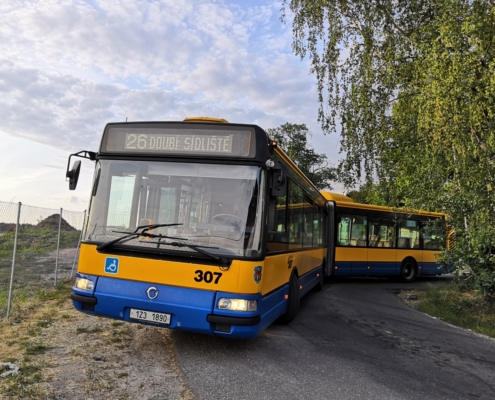
Soon the space opens up again, a mix of newer and older family houses appears on both sides, and on the left the embankment of railway line 037 from Liberec to Frýdlant and to the Polish border peeks out. We soon pass under the line by a small viaduct. To the right of it the train stop is briefly visible. Occasionally someone even transfers here. To the left, beyond the viaduct, the Kačák pond appears. It used to serve as a lido, and on the meadows around it events and festivals were often held. Kačák consists of two bodies of water; one of them was reportedly once called Žabák, but today both are Kačák. To the destination only a long gentle straight remains, along which the development of family houses thins out. Besides that, we can notice an old petrol station and a football pitch with a pub. On the way to Liberec we can admire the beautiful scenery of Radčice and the Jizera Mountains on one side and Ještěd on the other. Finally we reach a popular destination for foodies and beer lovers — the Krásná Studánka terminus. Right next to it is the well-known restaurant and guesthouse Studánecký medvěd (the Studánka Bear), usually nicknamed simply "u medvěda" (at the bear's). Although we are almost at the very edge of the city, people like to make a trip here for good food. The same goes for the Studánka microbrewery, which is just a few streets away. The vast majority of services end here, but some, after all, do not...
The services that continue all the way to Stráž nad Nisou can be counted on the fingers of one hand, but perhaps they are all the more interesting for it. Selected ones do not even pull in to the Krásná Studánka loop, but turn off from Hejnická street straight into Studánecká, or vice versa. At the time of writing there are only two. Those that do pull in then have to return almost to the Krásná Studánka Švestková stop, where the junction with Studánecká is. The journey along this route gives us a more detailed look at Kačák, as we drive practically right along its bank. The narrow street again leads through a mixture of old Stráž nad Nisou with hundred-year-old cottages and homesteads, among which beautiful houses from this millennium wedge themselves. Once we drive around Kačák, another gentle straight awaits us, but with a pronounced horizon, beyond which is the only en-route stop of this section — Na Vršku. After descending the little hill we reach the centre of Stráž nad Nisou, which is defined by Bergrovo náměstí with the Church of St Catherine, a restaurant, an open-air cinema and a sports ground. Here the route of the 26 meets the route of the 30, which arrives from the opposite direction of the city. Here its story also ends. A peculiar atmosphere is had by the first and last service of line 26, which here changes into line 30 and continues on without a break. Into the dark night you occasionally bring a stray passenger here, but otherwise I enjoy absolute calm here, with a view of Ještěd and the starry sky. It is also worth mentioning that, correctly, this square is driven anticlockwise. For the mentioned services, however, it is shorter to drive it clockwise, and that is usually what I do, since only very exceptionally is there anyone who might notice. Such a passenger, though, just gets off or on on the other side of the street, opposite the stop post.
The three-line group made up of lines 13, 24 and 26, which share most of their route, is unquestionably my greatest "favourite". From an early age I rode it from Doubí to Pavlovice to visit my grandmothers. Later in childhood and adolescence I rode it daily to ZŠ Vrchlického, then to grammar school, to pubs, to the authorities, on trips, to the Prague bus for university, and so on as life went on. So I mainly used the part between Doubí and the centre, but occasional trips to Pavlovice and other parts continued. And today I am part of it again, but no longer so much as a passenger, rather as a driver. On today's shift, in fact, I have one round to Radčice, two to Krásná Studánka and the last all the way to Stráž ahead of me. So it can be said that this three-line group has become, in its so-far unchanged form, an unshakeable part of my life. It has been so for almost 30 years. I know every house here, every hole in the road. I know, and have often seen, how various buildings have come and gone along the route over time, as the city constantly changes. If I were to write down all these memories, it would fill a whole book about a single bus line. In this article, of course, I will be more concise.
Insensitively placed housing estates
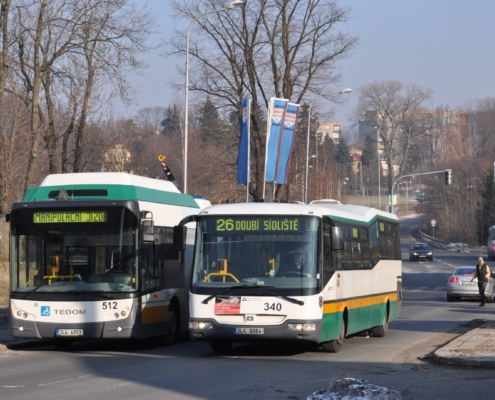
The southern end of the route serves two Liberec estates, Doubí and Vesec. There the route is characterised by a dense network of stops. Although Vesec and Doubí used to be small picturesque villages just outside Liberec, old original houses are now few in these locations, and most of them lie further from the bus route. The village character full of meadows and fields was changed in the last century by giant concrete colossi — panel blocks built on extensive green meadows. We drive around the Doubí estate on its southern side, opposite which we find smaller terraced houses. Beyond the traffic-light junction, where there used to be trees, we also pass a relatively new football pitch, which, however, is already in the Vesec cadastre. By the roundabout we pass an old, now barely noticeable bus turning loop and drive past the majestic Vesec school with its Sokol hall, which still recall the old days of quality architecture. A little further on, however, panel blocks begin on the right, on the left there is still an old post office with a shop, and beyond that older and newer villas. But these last only a moment, and soon more giant "rabbit hutches" appear on the left. On the right the long-dilapidated building of the Libena factory is worth mentioning. After leaving the estate we descend a steep hill past a timber shop that I remember there from childhood. Below the hill comes a passage through a once-whole, now divided and modern industrial plant. After a sharp bend, with a small ghetto on one side and a former pub and gym on the other, we reach a level crossing that separates the next stage of the route.
Through the valley of the Lužická Nisa
The level crossing can hand out a delay of several minutes too. Right beyond it we enter Poštovní náměstí, where the first tram route in Liberec once ended, and a bus line ended here too. Now, however, no one would even think of it; the square changed beyond recognition around the new millennium. It is characterised rather by the fact that part of it is hidden under the flyover of the Liberec–Jablonec expressway. Another peculiar characteristic of this square is that on it and in the immediate surroundings there are about 4 non-stop bars/gambling halls. I never figured out why they concentrate right there; I never saw a large number of people in them, but they have survived there for years. On this square our three-line group also joins lines 20 and 37 and continues with them to the centre along Dr. Milady Horákové street. It is lined on both sides by older houses with various services, behind which, on the left, the Nisa river is hidden, on the right more houses and, right next to them, a rock massif on top of which the edge of the Rochlice estate is visible. The houses are occasionally replaced by various facilities, such as the Kaufland store built on a former factory. Other old factories in the Nisa valley did not get demolished and were rebuilt. Beyond the Čechova stop the main landmarks are the law school and the Liberec heating plant and incinerator. The houses on the right grow larger, but only up to the next traffic-light junction by the Melantrichova stop. On the right it is lined by a strange no-man's wood before we reach a petrol station and more villas. On the left various industrial facilities continue.
The busy city centre
The junction with Košická street, in my eyes, separates another stage — the stage of the centre. For now we still skirt a little park and more villas, but soon we reach the tall buildings of the regional authority, the S-tower, the labour office and others, which mark the approaching Fügnerova public transport terminal. Suddenly we find ourselves in the lower centre of the city, full of shops, restaurants and the Fórum and Delta department stores. Those who remember will recall the old Ještěd department store, which had its die-hard supporters and opponents. As we extricate ourselves from this airy space, we find ourselves in the somewhat darker 8. března street, lined with fairly tall old apartment houses. Soon, however, we pass the Liberec little chateau and suddenly find ourselves in another airy space dominated by the Plaza shopping centre and the largest Liberec junction, Šaldovo náměstí. With the bus we split off onto a dedicated road shared with other lines, including tram lines, which directly adjoins the Plaza. After overcoming the Šalďák, we again plunge into a narrow dark street between tall houses that remember much. One of them is the old post office, still the main Liberec post office today. We briefly glimpse the F. X. Šalda Theatre and the town hall, but quickly disappear at the stop under the bridge on Sokolská street. Beyond it we can again briefly glimpse the modern regional research library and, downhill, leave the city centre at greater speed.
The calmer part of the route
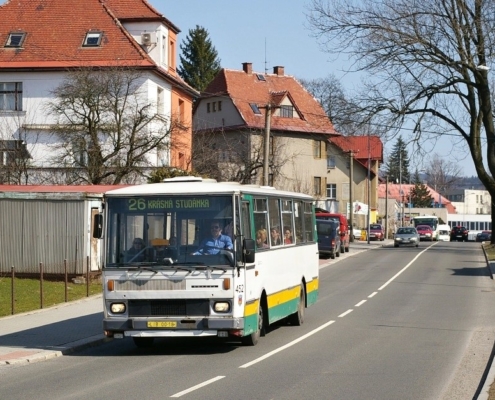
At the next traffic-light junction we turn left and the character of the city changes again. The rest of the route follows a road hundreds of years old into the northern corners of Bohemia. At peak it tends to be fairly busy, but on quiet evenings it can be driven the whole way without stopping. In general this half of the route is much calmer than the first part. We pass a small theatre and find ourselves on a neat straight street that blossoms beautifully pink in spring. We pass a mixture of villas and modern houses with services. Behind them we can only sense an interesting youth hostel with a rich history and architecture resembling a chateau, and a little further the Jedlička Institute by a beautiful villa district. But already we descend a sharp S-bend to the traffic playground and, opposite, glimpse the main football stadium. Dopravní hřiště (the traffic playground) is also the name of the adjacent stop, at which it does not often stop, but during a football match there can be downright crowds here. After the S-bend descent, though, we have to climb back up the hill again. We pass, among other things, a former hotel, now the Atrium retirement home. When we climb the hill to the Vrchlického stop, the strange socialist department store Merkur appears on the right. It was from here that I, with many other pupils, walked to ZŠ Vrchlického, though some also to the adjacent ZŠ Sokolovská and the Podještědí Grammar School. Beyond the next bend follows a straight with a vet's, a strange casino, and it ends with a very sharp bend, beside which stands the building of the Universum International Centre, otherwise also called the Colosseum. For decades now, cultural and educational events, among others, have been held here. Beyond the bend we soon reach the Hrdinů stop, where there is the well-known pub Václavka and a building where various services come and go over time. Up the next hill we already drive through a little wood that somewhat darkens the whole street. Beyond the wood, however, the Nové Pavlovice estate and the adjacent garages peek out. On the hill by the Letná stop there used to be a classic estate corner shop. Now motorbikes and quad bikes are sold there. The shop was replaced by a Billa supermarket opposite. But even that did not last and turned, after a few years, into an industrial building. Ahead of us is only the steep descent through an overgrown valley to the Pavlovice junction, during which we glimpse the Nové Pavlovice estate on the left and, on the right, a notorious house with notorious residents. With that this account ends. The area of the Pavlovice křižovatka loop is the terminus of the larger part of line 24 services, but it is also a place with an immensely rich history, which you could discover in the account of the remaining parts of the route of lines 13, 24 and 26, which branch here and each continue elsewhere.