ROUTE FUNCTION
The number 31 first appears briefly back in 1995 on the route Fügnerova - Benešovo náměstí - Růžodol I - Stráž nad Nisou/Elitex. It operated only during weekday peaks and thus reinforced line 12. Selected services continued from Růžodol I either to Stráž nad Nisou or got onto road 35 and went directly to the Elitex plant. Already on 1 January 1996 it is merged with line 23 and renumbered, so its short era ends for several years.
The number 31 appears in the list of lines for the second time on 1 September 2003 as an express line to the new southern industrial zone, on the route Růžodol I – Ruprechtice sídliště – Fügnerova – Průmyslová zóna jih, in the opposite direction running only to Fügnerova. There were only a few extended services from Růžodol I, whose main task was to collect employees before the run-in for shift changes.
- 1 September 2006: the Růžodol I - Šaldovo náměstí section was abolished (replaced by line 34). The line now starts from the Šaldovo náměstí stop (with one service; the others start at Fügnerova). Interestingly, from this date the original stops are still in the timetable. The extent of services between Fügnerova and PZJ was already similar to today's back then.
Line 31 is a typical workers' line. That entails peculiarities for the driver too. You have to reckon with overcrowded services; conversely, some nonsensically timed services may be almost or completely empty. The same applies to the operation of this line on, for example, the Christmas holidays and other days off. Most services are run with articulated vehicles.
The route has only two awkward spots: the entry onto the through road (road no. 35), which is very sharp and with an articulated bus it is not easy to fit between the kerbs, and the exit from the same road, which is also not ideal because the slip lane is too narrow. And finally there is the turn beyond the Banskobystrická stop, which is likewise very sharp and has poor visibility, with a risk of blocking the turning loop.
The first video captures the only service that starts already at Šaldovo náměstí. It is a service for the morning shift and you can see for yourself the number of people boarding and then alighting. The video starts with a non-revenue run from the Nám. Dr. E. Beneše stop. This is because this service is preceded by a run out of the garages, and the usual practice is to wait at this stop until departure time so as not to block Šaldovo náměstí. Another point of interest in this video is, of course, the weather. Several centimetres of snow had fallen overnight and not all roads had been cleared; moreover, it was still snowing lightly. Given that it was an old articulated Irisbus Citybus 18M #307 with not particularly good tyres, it was a fairly adrenaline-filled ride. At some stops you can hear the ABS system working. The journey also took about 7 minutes longer than usual.
The return journey was filmed during the Friday afternoon peak, but it is a later service departing before 5 p.m., when the roads are already fairly passable. The service runs along a long-term diversion that avoids the road no. 35 through route.
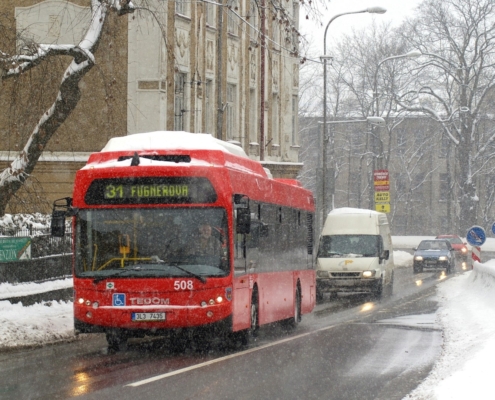
From the centre through the valley of the Lužická Nisa
From the terminal we set out through the parking house adjoining the OC Fórum, along the one-way Blažkova street and then Náchodská. I remember the time when these streets were used only as a replacement route in case it was not possible to turn from the terminal into the then two-way Dr. Milady Horákové street. Now both streets are used, one there and the other back. Some may still remember that a tram route once ran along this street to old Rochlice. A view awaits us of the tall regional-authority building, the little park with a future riverside walk and, behind it, the IQ Landia building visible through the trees. Right after that we appear at the busy junction with Košická street. We also meet the Lužická Nisa. Beyond the junction follows a long section that strictly separates industry on the right from mostly residential blocks on the left. The left side is interesting in that it rises steeply. At first it is rather villas, then a petrol station appears, which was known precisely for being closed for many months due to a rockfall from the slope. Beyond the petrol station is a strange little wood, through which a tram to Rochlice may one day lead. On the right we drive around various warehouses, a scrap-metal collection point, but above all the Liberec heating plant and incinerator. The only thing standing out from the whole industrial complex is the building of the Secondary School of Law. As far as Čechova street we share the route with several other lines, but from now on we set off on a route along which no other line runs. Čechova street I know well — I once walked along it daily with other students from the Čechova stop to the Jeronýmova grammar school. The only interesting thing about it is perhaps that by an inconspicuous bridge it crosses the Lužická Nisa, and right afterwards the siding to the heating plant and on to the transport company's tram depot. In sight is the city through route carried on a long bridge, and the slip road onto it. In this no-man's-land, which underwent a radical change in the 1970s during the construction of the through route, one strange little house remained, in which a security agency now resides. The entry over Nákladní street is very sharp, and with an articulated vehicle it is no joke to stay on course without the kerbs.
Back a different way
Since at this spot there is only an entry and not an exit from the through route, on the way back the line goes a different way. It has to go to the next exit, which comes out by the well-known Babylon Centre, which arose from the reconstruction of the Hedva industrial complex. We cross the siding, which at the junction by the Babylon becomes part of the road, and soon, past the dubious hostel with a car park, we reach the junction with Dr. Milady Horákové street, where the route only then merges with the route in the direction from the centre.
Onto the through route
But back to the original route, where we get onto the city through route. Road I/35 is the main through route of Liberec and at the same time a link with Turnov, Chrastava, Mladá Boleslav and Prague. We will not have much time to look around: on one side we can watch the throat of the Liberec station, behind which the arena and the adjacent sports centre rise, on the other we can appreciate the view of the city centre, but rather mainly of the panel blocks of the largest Liberec estate, Rochlice. At the same time we can only imagine what the place looked like before the construction of the through route in the 1970s. Doubská street, winding below us, was a calm little street with older houses around. We still glimpse the former Baumax, where for years there has been only an empty car park, and we are already coming off the through route again, straight into a fairly steep hill towards the roundabout of České mládeže street. Here we find ourselves in the middle of another industrial complex. Around us is the grounds of the technical services, a petrol station, car repair shops and, a little way off, the entrance to the shopping zone dominated by the Nisa shopping centre. We do not go there, however, but continue along the long street. We cross line 030 towards Turnov and finally reach another industrial complex, which could already be counted as part of the southern industrial zone. Here we have to drive around several plants.
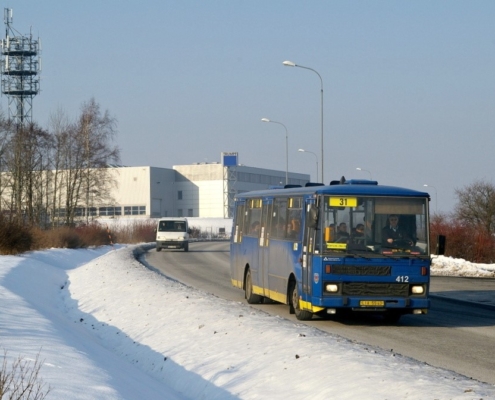
An industrial zone, a shopping zone and detours
The industrial zone is a journey from older history to newer. It begins with the former, now modernised building of Plastimat, today Magna International. We drive past it even before the roundabout, where few people suspect that behind the noise barrier a small residential zone is hidden, which remained as a relic of the original character of this landscape before industry and traffic took it over. Beyond the roundabout, where České mládeže, Kubelíkova and Průmyslová streets meet, a detour awaits us straight to the entrance of Magna, the Banskobystrická stop. From it we return to the roundabout. Selected services start from the České mládeže loop, which is up the hill from the roundabout, but none end there. The local industry grew up back in the 1980s. The first services here began in the 1990s to the Škoda works. Today many smaller and larger companies are based in the area. As it is again only a detour, we have to return to the roundabout. The next, last exit takes us into the new industrial zone, built gradually since 2003. In the place where I remember extensive fields and meadows, we now meet only a heap of grey boxes. Yet this place has a certain poetry, and it concerns the daily rhythm. From the very beginning it fascinated me that for most of the day the whole zone is fairly calm. Before a shift change, however, the traffic begins to grow noticeably. The best time to observe this is around 2 p.m., at the changeover of the morning shift for the afternoon one. Already from 13:15 the traffic thickens and the first buses begin to arrive. By 13:45 only the last latecomers are arriving and the lay-by areas are overflowing with waiting buses. At 13:55 absolute calm reigns in the zone. At 14:00 the doors burst open and crowds of people begin to stream out of the halls. At 14:15 there is life everywhere, buses depart and a queue begins to form at the exit from the zone. At 14:30 the queue still holds, but around the halls it is once again completely calm.