ROUTE FUNCTION
LIST OF STOPS
In 1932, after five years, a new city line was introduced for the first time. Until then only line 4 from the town hall to Ruprechtice had operated. On 15 May line no. 5 (Radnice - Harcov) was also introduced, and right afterwards, on 10 June, line no. 6 (Radnice - Nádraží - Janův Důl). In 1933, during the difficult situation of the harshly impacting global economic crisis, however, a radical curtailment of operation began. Neither line 5 nor line 6 was profitable, so they were first merged into one. Even that did not help, and so on 11 September it was decided to discontinue their operation. In the following years bus operation was provided exclusively by private operators.
Bus lines reappeared in the city's hands only in 1939. The number 5 was given to the line to Ruprechtice, but unlike lines 6, 7 and 8 it passed under the city only from 1942. Selected services (6 of the 22 a day) continued via Kateřinky all the way to Rudolfov. The changes after the end of the Second World War eventually led to lines being marked with letters, which definitively ended the era of bus line 5. The line to Ruprechtice continued under the designation D.
Operation of tram line no. 5 began on 27 June 1966 after the completion of the passing loops by Textilana and Lékárna. For the time being it terminated in Vratislavice by the church. Soon, however, it was replaced by buses for a lack of vehicles, as confirmed by the note in the 1972 timetable below. Shortly afterwards, moreover, a large-scale reconstruction of the track began.
Only on 31 December 1975 was the Vratislavice nad Nisou loop completed and line 5 introduced roughly in its present form, that is, as a reinforcement at peak times.
From 1 September 1998 some services run all the way to the Viadukt loop.
Although line 5 copies the route of line 11, it can be described as a considerably more relaxed line. This is of course because it terminates already in Vratislavice, so passenger demand is naturally lower, and at the same time there is no need to keep to the single-track passing schedule, as the track is almost entirely double-tracked in this part. The line also lacks the trouble spots beyond Vratislavice, yet there are still plenty of them — mainly the many crossings right in Vratislavice.
The driver's view begins with the full route of the line, that is, all the way to Viadukt, which is served at weekends and otherwise only by selected services. Both journeys are with a T3R.PLF car, #23 there and #45 back. My thanks to colleagues Dalibor B. and Martin B. for the footage.
In 2021 the section to Vratislavice was re-gauged and large-scale construction work began on the remaining section, which required a several-month closure of the entire route. The Vratislavice nad Nisou, výhybna loop was also closed, which affected the route of the X5 replacement bus service. It turned around via the U Cukrárny and U Závor stops, which are normally served only by school services of line 59. The line officially ended at the U Cukrárny stop and started at the U Závor stop. Between these stops there was a rather interesting non-revenue run, which you can see as part of the journey from the centre in the following footage. Both journeys also retain the non-revenue run to and from the tram depot. Filming took place on a pleasant autumn day with an Iveco Urbanway CNG #528.
Both lines run on the same route and overlap, so they share a single local-geography article.
A link between the largest cities of the Liberec Region
The second tram route passing through Liberec also deserves a superlative from me. You may think I am biased because I grew up in the region. Of course I am a little, but how else to describe a route that people come to ride from literally all over the world, precisely for its uniqueness and beauty? The uniqueness lies in certain technical parameters, but also in the beauty of the nature it passes through. The technical points of interest are discussed in more detail in the line's history. Now to the local geography.
The route is intercity, which in itself is also not exactly typical for a tram route. It connects the two largest cities of the Liberec Region — Liberec and Jablonec nad Nisou. The very fact that Liberec lies in a basin and Jablonec somewhat higher in the Jizera Mountains suggests that the route will pass through beautiful Jizera Mountains scenery. I am proud that I used the 11 a lot as a passenger, because in my childhood and youth I travelled to family in Proseč nad Nisou along the way, and later, when we moved to Jablonec for a time, I would travel to Liberec and back to see friends. What did I experience on each of those journeys?
Through the centre of Liberec alongside the other lines
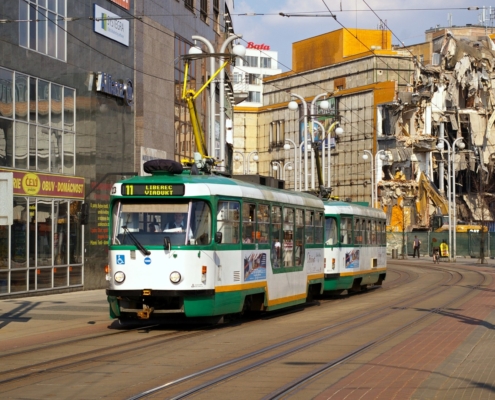
From Liberec the tram usually sets out from the Viadukt loop, which still belongs to the city route, and here we can also meet the trains of lines 2 and 3. The journey begins with a steep hill to the first important stop — Nádraží. On the left we pass the bus station, on the right is the railway station. Right after the next junction we pass the odd functionalist Uran building, and opposite it the open space where the old majestic customs house once stood. There the route changes gradient and we go downhill, a hill which thousands of people travel every day between the stations and the public transport terminal. On the slope we pass the famous Hotel Imperial, today run by a private company. At the bottom of the hill we meet the turn-off to the Rybníček depot and the stop of the same name. I often used this stop to board before the terminal, because at the terminal a crowd of people usually waits and reliably fills the whole set. Between Rybníček and the Fügnerova terminal we also pass the house of culture, a few small shops, Soukenné náměstí and the Fórum shopping centre, which today dominates the lower centre. It is not so long ago that the famous Ještěd department store with its unique design stood here. At the Fügnerova terminal the tram usually waits until its departure time and finally sets off straight onto the route to Jablonec, still on the metre gauge.
A scenic ride past craters
Without the tram leaving the city centre, one suddenly finds oneself in a strange world. One of the sad distinctions of the city of Liberec — besides the highest debt and the highest area of shopping centres per person — is that right in the centre it has huge holes and wastelands left by unfinished construction. The first crater has been slumbering for years right next to the public transport terminal. We reach the second monument only a moment later; it is more of a wasteland. This wasteland is what remained after the demolition of the former huge Textilana works in 2005. As a child I still remember it; the tram used to drive around the whole complex and I would watch it from the window of my great-grandmother's flat. We always complained that the trams squealed on the curves. In 2011 the tram route was straightened through the complex, and shopping centres were first meant to rise around it, then flats. Yet to this day nothing has been built, so for years the tram has passed through an empty space lined with the remains of building foundations, on which an almost pointless stop sticks out, recalling the faded glory of Textilana. After overcoming this sad sight we reach a pond that once served this factory. It does not look very nice, but it is better than a wasteland. Further on, the route on its own track-bed mercilessly cuts through a hill to swing up above Liberec to the so-called rušička — a hill apparently named after a former signal jammer. Right behind the rušička we reach a social-care institution, opposite which a new modern housing estate has been built. But even that does not much hinder the wonderful view of Ještěd, its whole ridge and the southern Liberec districts. It is precisely that part of the ridge behind which the sun sets for most of the year, so on my trips to Liberec pubs I always sat on the left side. Now, however, we have to descend again into the valley of the Nisa river. We pass the Pivovarská and Lékárna stops. At present there really is a pharmacy (lékárna) by the Lékárna stop, and near Pivovarská is the Konrad brewery.
Vratislavice nad Nisou
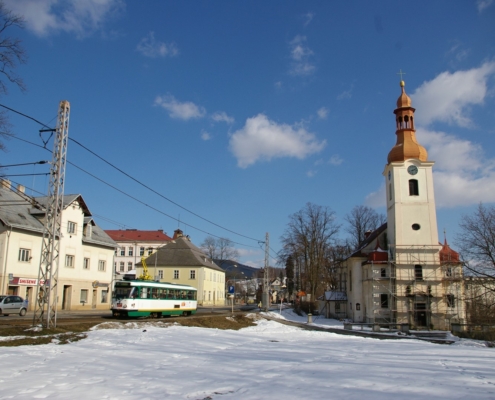
We finally reach the Vratislavice nad Nisou, kostel stop. Here comes relief for the people of Proseč and Jablonec, because about half the tram now gets off and heads for the large Vratislavice housing estate. We must not forget the unique Holy Trinity Church on the right. We descend a gentle hill to the passing loop where the 5 terminates, and a little further on we continue along the old, as yet unreconstructed track (2021). One recognises the change in the track's age without looking at the rails or knowing the historical background. From a fairly ordinary ride the tram suddenly begins to jump and throw you in all directions, so that at times it is hard to stay in your seat. The development has thinned out and the route has finally entered the picturesque rural valley of the Nisa river. Before long the route even almost merges for a time with railway line 036. In places the tracks are literally only a few metres apart, and it is not unusual to see a train passing alongside a tram running slightly lower. The route follows the course of the Nisa and, across meadows, little woods, minor roads and past mostly older buildings (in places very close), it races through the village of Proseč nad Nisou. In Proseč there used to be the boundary between the Liberec and Jablonec parts of the route; now it is at least the boundary of the tariff zones. It is a pleasant sight in any season. The combination of the picturesque old sub-Ještěd landscape with the old track takes the passenger a few decades back. Here and there we come across some industrial plant making use of the fall of the Nisa; you can even pass the skeleton of a never-finished multi-storey warehouse, which sticks out like a sore thumb beyond the Proseč, pošta stop. The best-known plant in the valley, however, is the Vratislavice mineral water works (Vratislavická kyselka) with its unique but, sadly, markedly dilapidated building. The kyselka has not operated for many years, but recently a new investor took over the building and would like, after reconstruction, to start producing drinks there. A plant making lifts then ends Proseč and starts the next section, in my opinion the most beautiful.
Through deep forest
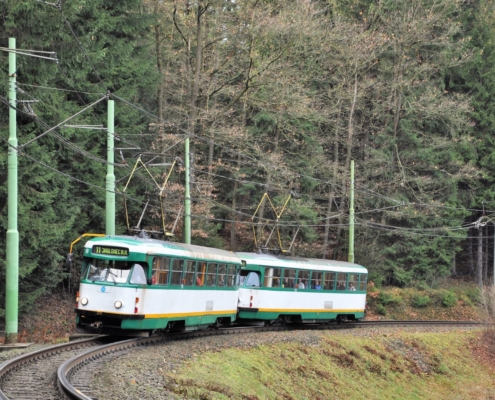
What follows is a no-man's-land between Proseč and Jablonec nad Nisou. But it is a beautiful no-man's-land. Calm, quiet. The quiet and calm are disturbed only by the occasional passing tram or train. Even the road has been quiet ever since the expressway between Liberec and Jablonec via Kunratice was opened. The tram passes through the pure Jizera Mountains with everything that belongs to them — dense spruce growth, mountain ferruginous streams and typical granite crags. Through this environment the track slowly climbs to Jablonec, along a valley carved out over millennia by the Nisa river. The most beautiful view is on the journey the other way, that is, from Jablonec. If you sit on the right side, you can see the whole valley, in which, on cold evenings or early mornings of late summer, fog drifts. I will never stop being grateful that I can see such pictures during such ordinary activities as travelling to work, from work, to family, to friends. Each such activity suddenly becomes extraordinary and one feels no need to shorten the journey. The journey suddenly becomes the destination.
The forest ends with the chimney of the Jablonec heating plant Brandl; at the same time, the tram here again briefly meets the train at the Jablonec lower station, with its beautiful station building, which, however, long ago lost its importance. It is not so long ago that almost no train even stopped at this station. After the Brandl passing loop the tram only climbs to the first Jablonec housing estate and then descends to Tyršovy sady, where it terminates. Tyršovy sady is a park, but for some reason it is not a very suitable place to rest. At present we do not get to see much of Jablonec from the tram, because we end at its edge. An extension at least to the bus station has, however, been actively discussed in recent years. It seemed the construction was imminent, but the subsequent political disputes reminded everyone that nothing is certain until it is done. Bringing the route closer to the centre of Jablonec would undoubtedly increase its importance.